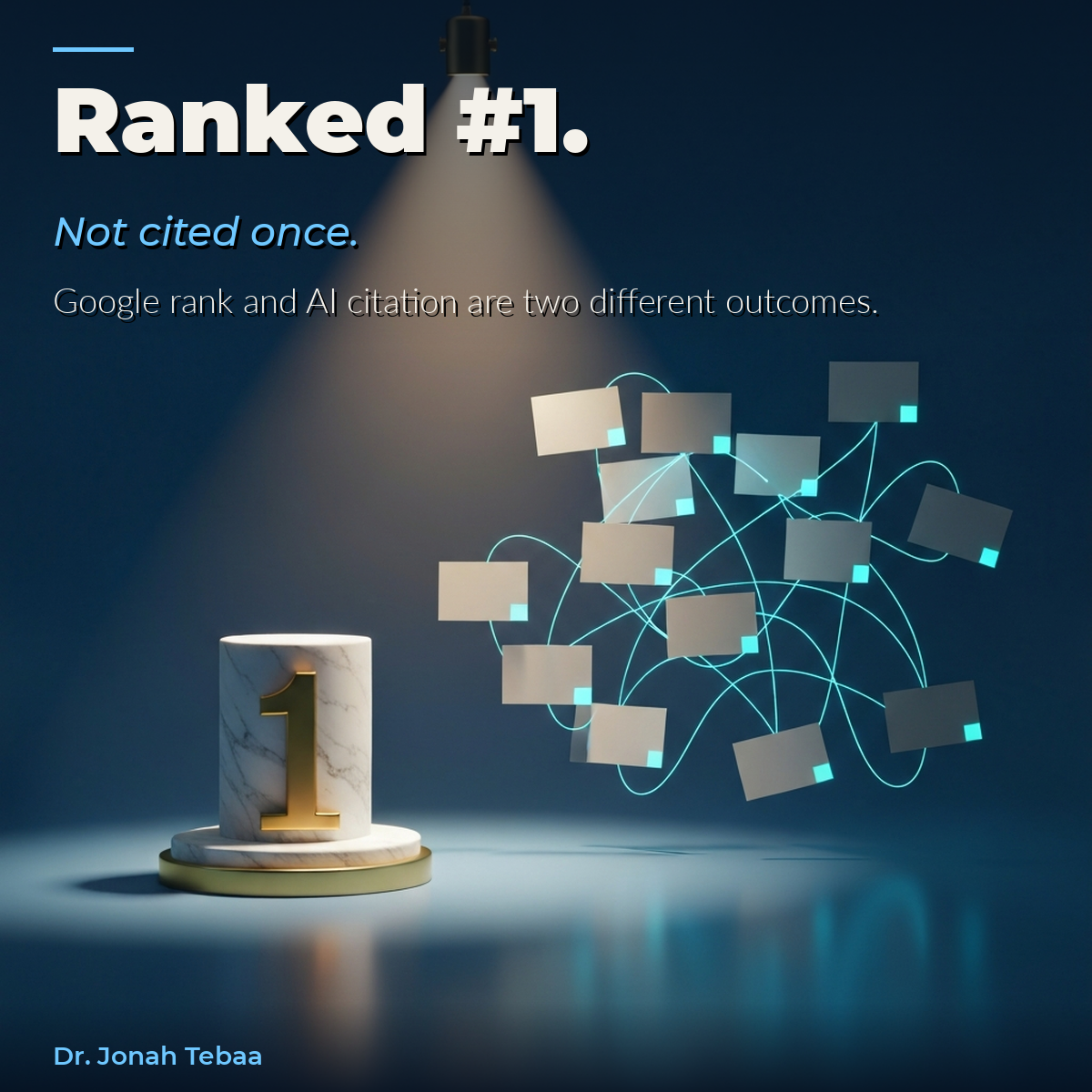
There are now two distinct audiences for every piece of content your brand publishes. One is human. One is not. They are scored by completely different criteria.
This distinction has been building for years, but in 2026 it has become impossible to ignore. Most content strategies I review are still built for only one of these audiences.
When someone searches on Google, they receive a list of pages. They make a choice. A ranking earns a position in that choice. The human decides whether to click.
When someone asks ChatGPT, Perplexity, Claude, or Google's own AI Overviews and AI Mode the same question, the model responds directly. It either cites a source or it does not. If it cites a source, that source becomes part of the user's mental map of authority. If it does not cite your brand, your brand simply does not exist in that interaction.
That citation decision happens before the user sees your name.
This is the divergence problem: Google visibility and AI citation visibility are related, but they are not the same outcome. Ranking on one does not guarantee presence in the other.
What Makes Content Citable?
The first signal is definitional clarity. AI models are answer engines. They favor content that defines things with precision. If your content explains a concept in a way that is clean, bounded, and attributable, a model can use it. Vague editorial content gets passed over. A tight, author-attributed definition of a specific concept is far more useful.
The second signal is attributed specificity. There is a meaningful difference between vague claims and precise claims connected to a named source, a date, a geography, and a defined context. AI systems have absorbed a standard for what a citable claim looks like. Content that meets that standard has a better chance of being referenced.
The third signal is structured Q&A architecture. Models are trained to answer questions. Content built around real questions, with direct and specific answers, maps naturally onto how models retrieve and compose responses. A precise FAQ section is not a dated SEO tactic. It is citation-ready infrastructure.
GEO Is a Strategy Layer, Not a Tag Layer
Generative Engine Optimization is often discussed as if it were a technical add-on: add schema, update metadata, improve markup. Those details matter, but they are not the architecture.
The deeper work is deciding what your brand should be the definitive source on. You cannot be cited for everything. You have to identify the concepts, categories, questions, and use cases where your brand should own the answer, then build content that earns that position with clarity and consistency.
In the traditional model, content is a page — a destination someone reaches after a click. In the GEO model, content is also a source — a body of knowledge that a model may draw from when constructing an answer.
A page is optimized to attract a click. A source is optimized to be trusted, cited, and attributed. That shift changes everything about how you decide what to write and how to write it.
That shift changes the topics you prioritize, the specificity you demand, the way you define terms, the way you attribute claims, and the way you structure internal content so it becomes coherent to both humans and answer engines.
What Google and the Behavioural Data Actually Say
Two published sources are worth putting against this argument, because between them they settle the part of it people most often dispute: whether the citation layer is a different competition from the ranking layer, and whether losing it costs anything.
On whether it is a different competition, Google’s own guidance on optimizing for generative AI features is explicit that eligibility is a separate gate rather than a by-product of ranking well: a site must be “included in Search generative AI features in Search Console” and meet the technical requirements “to be eligible for display in generative AI features on Google Search.” The same page tells you what does not earn a place there — it names special machine-readable files, content chopped into small pieces, and rewriting text into AI-sounding phrasing as things you do not need. Worth reading before buying any of them from a vendor.
On whether the citation layer carries traffic consequences, Pew Research Center tracked what 900 US adults actually did across 68,879 searches in March 2025 and found users “less likely to click on links to other websites” when an AI summary appeared: a result was clicked on 8% of those visits, against 15% when no summary was shown, and roughly 1% clicked a link inside the summary itself. That is observed browsing behaviour, not a survey of stated intentions, which is why it is the stronger evidence — and note that the second number is the honest one to quote. Clicks did not vanish; they roughly halved, and the half that remains is increasingly awarded to whoever the summary names.
Caveats, since they matter for how much weight to put on this: the Pew panel is US-only and single-engine, and both sources describe a fast-moving surface that will have shifted by the time you read them. What holds is the structural point — a ranking system and a citation system are scored separately, and a page can win one while losing the other.
The Citation Economy
In the citation economy, the currency is not only impressions or rankings. It is attribution. Being cited by an AI model in a high-intent answer can shape a buyer's view before a website visit ever happens. That makes citation absence expensive, even when your analytics do not show it. It is most expensive on comparison and shortlist queries, where the model rarely reasons from scratch at all — it paraphrases a comparison someone else already wrote, which is why finding the third-party page an AI assistant is actually quoting when a buyer asks it to compare you to a competitor is a more direct route onto the shortlist than another round of edits to your own site.
The brands becoming citation staples right now are building a body of work so precise, attributed, and answer-shaped that AI models can reach for it by default. They are not doing this by accident. They are doing it by deciding — deliberately — what they want to be the source on, and then building the content architecture that earns that position.
For brands operating in or serving the MENA region, the window is especially important. The amount of well-structured, AI-citable content from the region is still relatively thin compared with the scale of the market. A brand that builds disciplined GEO-oriented content now, in English, Arabic, or both, can create an early authority position before the field becomes crowded.
Two Scoring Systems. One Strategy Decision.
Most brands have a content strategy built around one question: are we ranking? That is a Google-frame question. It asks whether a human choosing from a list of links will find you.
The second question is newer and less comfortable: are we being cited? That is an AI-frame question. It asks whether a model constructing a direct answer will reach for your brand as a source.
The two systems diverge on almost every axis that matters:
| Dimension | Google Ranking (SEO) | AI Citation (GEO) |
|---|---|---|
| What the user receives | A list of links to choose from | A single composed answer |
| Unit of success | A position in the ranking | Being named as a source |
| You win by | Earning the click | Earning the citation |
| Content functions as | A destination (a page) | A source (a body of knowledge) |
| Optimized for | Keywords, backlinks, crawlability | Definitional clarity, attributed specificity, Q&A structure |
| Visibility decided by | The human, after seeing the results | The model, before the user sees your name |
| Failure mode | Ranked low, fewer clicks | Absent from the answer entirely |
The practical question is simple: when someone asks an AI tool to recommend, explain, compare, or define something in your category, does your content give the model a clear reason to cite you?
If the answer is no, your brand may be visible in the old search environment while disappearing in the new one.
The gap is measurable. The strategy to close it is available. The window, as always, is the constraint.
Continue Reading
- GEO Is the New SEO: What Happens When AI Reads Your Website Before Humans Do — The foundational shift from page-ranking to answer-sourcing.
- Why AI Strategy Matters More Than AI Tools — Building the architecture before the stack.
- The Delegation Gap: How Executives Get AI Authority Backwards — Applying the right framework to authority design.