Why do AI agents fail in production after working perfectly in the demo?
Because the demo tests the model and production tests the architecture. Almost every agentic breakdown traces to one of four structural gaps: context collapse, where the agent loses its operational thread without a durable memory layer; ownership ambiguity, where a failed handoff has no accountable owner; missing fallback paths, so the agent hallucinates or stalls in unexpected states; and silent failure, where it returns success while nothing downstream ever receives the output. The fix is plumbing, not prompts.
I have watched the same thing happen more times than I care to count. An AI agent gets built, gets tested, performs exactly as expected in a controlled environment, and gets approved for production. Then, somewhere in the first week of real operation, it breaks. Not catastrophically — quietly. A handoff that never completes. An output that goes nowhere. A task that the agent reports as done while the downstream system is waiting on something that never arrived. The model did not get worse. The environment got real.
This is the last-mile problem in agentic systems, and it is where most deployments die. Not in the model. Not in the prompt engineering. In the gap between what the agent produces and what the surrounding system can reliably absorb, act on, and recover from when things go sideways. If you have shipped an AI agent that worked in the demo and struggled in production, you already know exactly what I am talking about.

The Demo Worked. The System Did Not.
The demo environment is a liar. It has clean inputs, predictable tool responses, a stable session, and someone watching. The model handles it well because it was designed to handle clean inputs well. The problem is that production does not have clean inputs. Production has race conditions, stale context, APIs that return 429s at 3am, users who abandon tasks halfway, and downstream systems that expect a format the agent only produces 80% of the time.
Model capability and system resilience are two completely different properties. A model can be genuinely good — accurate, coherent, well-reasoned — and still fail consistently in a production environment because the system around it was never designed for autonomous operation. The demo tests the model. Production tests the architecture. Most teams build for the demo and are surprised when production behaves like production.
I am not writing this from a whiteboard perspective. I have been in the position of watching an agent pipeline fall over at 2am and tracing the failure not to anything the model did wrong but to a missing retry handler, an unlogged exception, and a handoff that had no defined owner. That is the failure pattern I want to break down.
Four Places the Last Mile Breaks
After enough production failures, the categories become familiar. Almost every agentic breakdown I have diagnosed traces back to one of four structural gaps.
The research literature is converging on the same shape. A 2025 study of agent failure, Where LLM Agents Fail and How They Can Learn From Failures, characterises these systems as agents "which integrate planning, memory, reflection, and tool-use modules" — and every one of those modules is a seam rather than a capability. A seam is where two things are joined, and a joint is what comes apart under load. That is the structural reason a demo tells you so little: a demo exercises the modules, while production exercises the joints between them.
- Context collapse. The agent loses its operational thread mid-task — most often across sessions, after a long tool chain, or when it hits an unexpected state mid-sequence. Without a durable memory layer, the agent restarts reasoning from scratch each time, which means it repeats steps, drops prior decisions, or contradicts itself. The model is not confused. It was never given the prior context in a form it could use.
- Ownership ambiguity. A handoff fails and no one — human or agent — is clearly accountable for resolving it. The task sits in limbo. This happens when agentic systems are built as pipelines without defined escalation ownership at each node. When step four of seven fails, the system needs a clear answer to the question: who picks this up? In most early deployments, that answer is nobody, because nobody built that path.
- Missing fallback paths. The agent hits a state it was not designed for and has no graceful degradation to fall back on. So it does one of two things: it hallucinates a path forward and produces a confident but incorrect output, or it stalls entirely. Neither is acceptable in a production system. A well-architected agent should have explicit handling for unexpected states — at minimum, a structured error output and an escalation trigger. Most do not.
- Silent failure. This is the one that genuinely bothers me. The agent completes its execution loop, returns a success signal, and nothing downstream ever receives the output. No error is logged. No alert fires. No retry is triggered. The system believes the task is done. The task is not done. Silent failures are the hardest to catch because they require observability infrastructure most teams do not build until after the first expensive incident.

This Is Not an AI Problem
The instinct when an agent fails is to go back to the model — adjust the prompt, change the temperature, swap to a newer version. Sometimes that is the right move. Usually it is not. The model is doing exactly what it was asked to do, within the context it was given, using the tools it was provided. The failure lives in the surrounding architecture. I have seen teams spend weeks prompt-engineering their way around a problem that was a missing retry handler — and every single one of them had a working model and a broken system.
Every operator who has actually fixed a broken agent system has fixed the plumbing — the memory layer, the error routing, the output validators — not the model.
The memory layer that does not persist across sessions, the tool integration that has no error handling, the output that is never validated against a schema, the exception that is caught and swallowed without logging — these are architectural decisions, and they are where the real work of building reliable agentic systems actually lives.
What a Production-Ready Agent System Actually Looks Like
A production-ready agentic system is not defined by its model. It is defined by the properties of the surrounding infrastructure. The systems that hold up under real conditions share a consistent set of characteristics.
- Persistent context across sessions. The agent's operational state is stored durably and retrieved reliably, so a session boundary or a crash does not reset its understanding of where a task stands.
- Defined escalation paths. At every node where a failure is possible, there is an explicit answer to the question of what happens next — whether that is a retry, a structured error output, a human-in-the-loop trigger, or a graceful shutdown.
- Observable outputs with structured logging. Every output the agent produces is logged in a queryable format. Every tool call has a trace. Every handoff is acknowledged or flagged. Silent failure is impossible by design, not by luck.
- Graceful degradation on tool failure. When a tool call fails, the system does not hallucinate an alternative or stall indefinitely. It executes a defined fallback, logs the failure, and continues operating within its remaining capabilities.
- Human-in-the-loop at decision boundaries, not at every step. Human review is expensive and does not scale. A well-designed system routes humans to the decisions that actually require judgment — approvals, exceptions, high-stakes outputs — and lets the agent handle everything else autonomously.
The operational layer we have built at Webspot is the direct result of solving these failure modes in production — not on a whiteboard. Every one of those properties above was added because its absence caused a real failure that had a real cost.
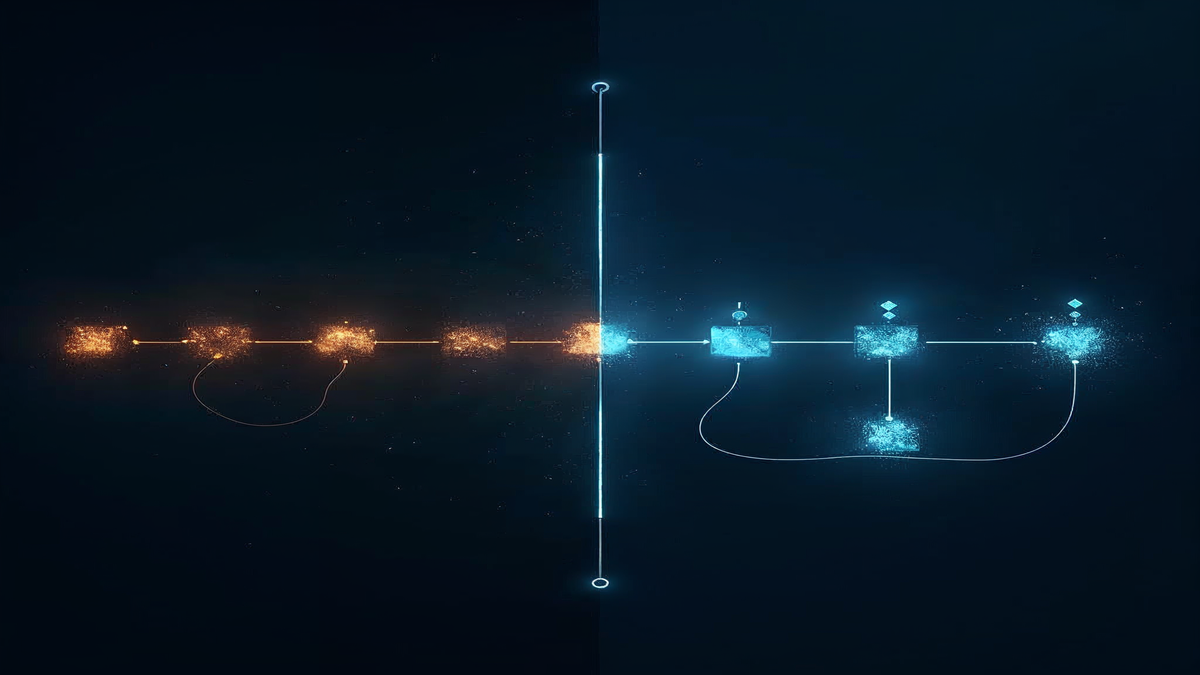
The Question Is Not Whether Agents Will Run Your Operations
That question is already settled. Agents are running operations now — in content pipelines, in customer workflows, in internal tooling across industries. The question that is actually open is whether you build the surrounding system correctly the first time or whether you learn the failure modes the expensive way, one production incident at a time.
The operators who are ahead right now are not the ones with access to the best models. The best models are available to everyone. The operators who are ahead are the ones who treated the surrounding infrastructure as the product — who built observability before they needed it, who defined escalation paths before they saw a stuck handoff, who asked what happens when this fails before the first deployment rather than after the third incident. I have since reduced that surrounding work to seven steps: name the exact workflow moment, specify the input contract, decide where the output lands, build an exception path, test with messy real examples, sample-review the early runs, and set a manual fallback for the days the AI step is unavailable.
That is the work. Not the model. The system. And it is available to anyone willing to build it correctly.