
Picture the general manager of a Beirut engineering-services firm. She is holding a vendor deck that says a client saved 1,000 hours and paid the tool back in five months. She is an illustrative composite, not a real client, and every figure in this article is invented for the example: illustrative, not a statistic.
She does the sum an owner would do. The tool costs $600 a month to run and $3,600 to set up. It would take over the formatting of 500 site reports a month, about 125 hours of coordinator time. She values those hours at the coordinators' wage, takes off the time spent checking the output, and sets what is left against the running cost. The hours are worth $400 a month. The tool costs $600. She would lose $200 every month, so no amount of waiting pays it back. Her partner says, "So it does not work here." She is not sure.
I am not sure either, and I think that doubt is the right response. The sum is correct for that one task. The mistake is treating it as the verdict on the whole firm.
Why the vendor's payback does not travel
Imported case studies carry three assumptions that are rarely stated. An hour of staff time is expensive. The tool is cheap next to that hour. And payback is simply hours saved multiplied by wage.
Bring those into a market where the tool is billed in dollars and routine staff time is priced much lower, and the first two assumptions can invert. The third then produces a bleak number for routine work. It also produces the wrong number for other work, because an hour is not worth the same amount everywhere inside the same firm. I have covered the invoice side of this in the four-line cost stack. Here I stay on the value side: what the hour, or the delay, is actually worth.
I am not asking you to distrust hours as a unit. I am asking you to price them honestly.
Three kinds of hour
Before dividing anything, sort the hour. In my work I use three kinds.
- Routine hour. Worth its loaded wage and no more. Formatting, copying, filing. On its own, this kind rarely pays back when the tool is billed in dollars.
- Billable hour. A senior hour you could really sell, or a team hour spent on a client who pays in dollars. It is worth the rate you would actually charge, but only if a client is waiting to buy it. A freed hour with no buyer is worth zero.
- Delay hour. Time spent waiting rather than working: days from request to quote, days from invoice to cash. It is worth the margin that goes cold or the cash held up while you wait.
The composite firm has three tasks, each with a different kind of problem. The first is formatting site reports, which is routine. The second is drafting quotes: the firm sends 40 a month, each takes about six days to leave the building, and it wins roughly one in four. The third is chasing overdue invoices: the firm bills $120,000 a month in dollars, and chasing happens when a coordinator finds the time.
A five-step local payback check
This is the check I would run on any single task before approving a tool for it.
- Pick one task and count its monthly volume from the last three months of records, not from memory.
- Value one unit at the highest honest figure. Use the loaded wage for routine work, the billing rate for time you will really sell, and for delay the margin you lose or the cost of the cash held up. Write down which one you used and how you got it.
- List every monthly cost of the tool in dollars, add the setup, and take the human's checking time off the value. I looked at how checking eats into saved time in the review tax.
- Subtract, then divide. Monthly gain equals monthly net value minus monthly running cost. If the gain is zero or negative, stop: the tool never pays back, however long you wait. Otherwise, months to payback equals setup cost divided by monthly gain.
- Set the bar before you look at the result, for example under nine months for a firm your size, and write down the date you will re-read it.
One caution before step 4. Check that the volume and the baseline are normal. If last quarter's quote count was unusually low, every number downstream is flattered or punished by it. I wrote about that trap in the denominator problem.
The composite, worked through
Again, an illustrative composite: the figures are invented. I use a loaded routine wage of $4 an hour and a senior engineer cost of $30 an hour. Both are chosen for the arithmetic and say nothing about real wage levels in Lebanon.
- Report formatting (routine). 500 reports at 15 minutes each is 125 hours, worth $500 a month. Checking takes 20% of that time, 25 hours or $100, so net value is $400. The tool costs $600 a month to run, so the monthly gain is $400 minus $600, a loss of $200. The gain is negative, so this task never pays back, and the $3,600 setup does not change that.
- Quote drafting (delay). Cutting turnaround from six days to two lifts the win rate from 25% to 27.5%, which is one extra job a month out of 40 quotes. A $20,000 job at a 12% margin is worth $2,400. Senior checking takes 16 hours at $30, or $480, so net value is $1,920. Running cost is $900 a month, so the monthly gain is $1,020. Payback: $5,000 setup / 1,020 = 4.9 months.
- Invoice chasing (delay and leakage). Faster chasing cuts lateness by 20 days on an average overdue balance of $60,000. At an assumed cost of cash of 1.5% a month, that is 60,000 x 1.5% x 20/30 = $600. Separately, 1.5% of the $120,000 billed, $1,800, currently ends as discounts or write-offs; chasing recovers half, $900. Gross value is $1,500. Checking takes 20 hours at $4, $80, so net value is $1,420. Running cost is $600 a month, so the monthly gain is $820. Payback: $2,400 setup / 820 = 2.9 months.
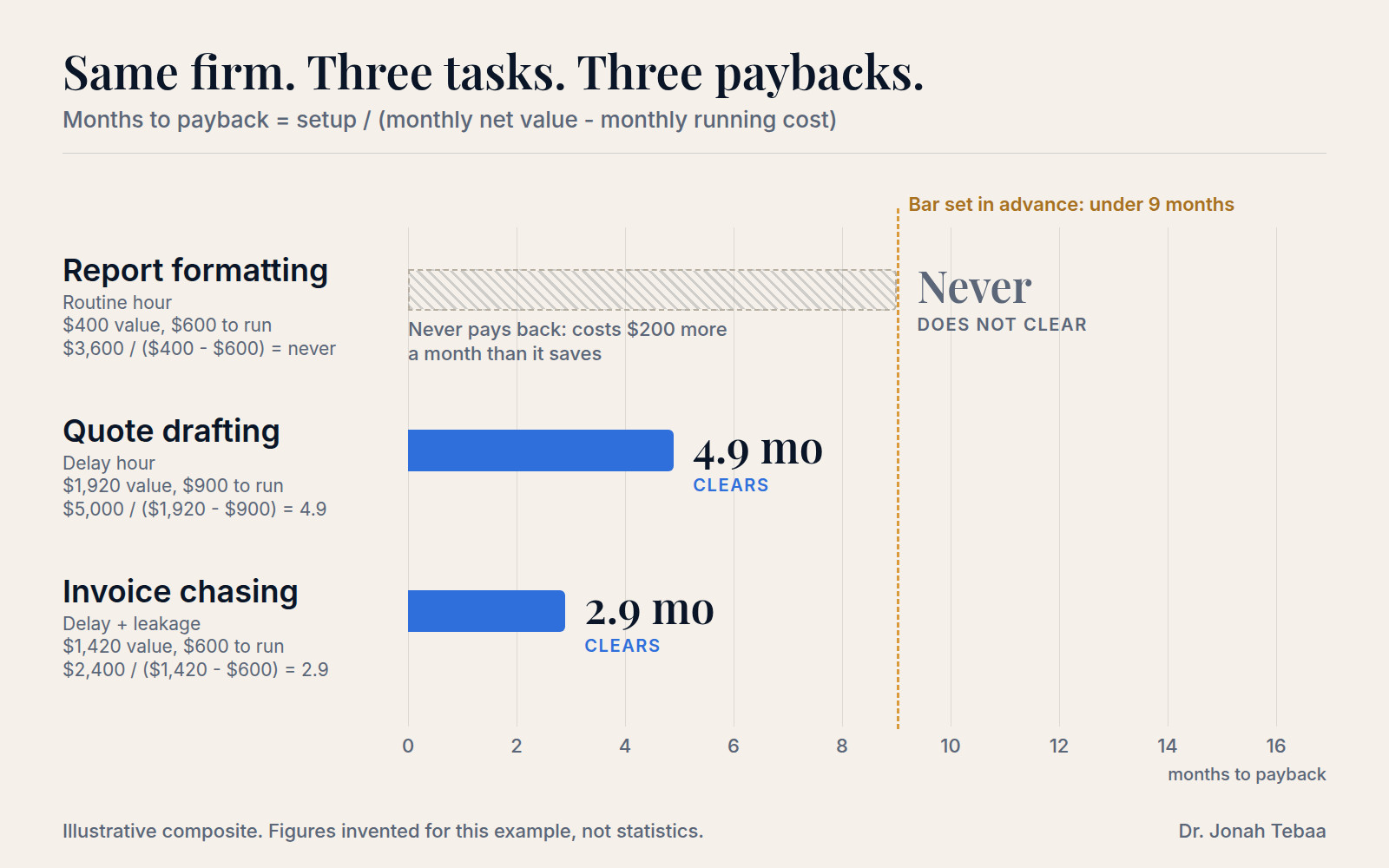
Same firm, same type of tool, three results: never, 4.9 months and 2.9 months. Against a bar of nine months, one fails and two pass. The deck's five months was never a prediction for any of them.
Which tasks still pay, and which to leave
In the SMEs I work with, the tasks that clear the bar are usually driven by delay: quote turnaround, invoice chasing, tender response. Next come tasks that stretch scarce senior time, and work billed to clients who pay in dollars. The tasks that rarely clear it are those whose only case is replacing low-wage routine hours.
A warning on the billable hour. If you value a freed hour at your billing rate, you must have demand to sell it. If the engineer's ten recovered hours go to the same slow Thursday afternoon, their value is zero. Count a billable hour only when a named client or proposal is waiting for it.
A routine task that misses the bar is not dead. It is unproven. Volume may triple, or the price of the tool may fall, so write down the date and look again.
The general manager in my composite did not fund the deck. She funded one task, quote turnaround, with a nine-month bar and a re-read date three months out. A vendor's case study is a question to put to your own numbers, not an answer to adopt. Run one task this week.
Related evidence: Customer support agents using a generative AI assistant saw a nearly 14 percent increase in productivity, measured on real work rather than estimated. (NBER's study of AI-assisted support agents, which measured a real productivity gain of nearly 14 percent)
In METR's randomised controlled trial, experienced developers expected AI to cut completion time and afterwards believed it had cut it by 20%, but measured completion time rose by 19%. (METR's randomised trial, where developers believed AI saved them 20% of their time while measured completion time rose 19%)