The Book · Published 6 September 2026 · Updated 20 September 2026By Dr. Jonah Tebaa
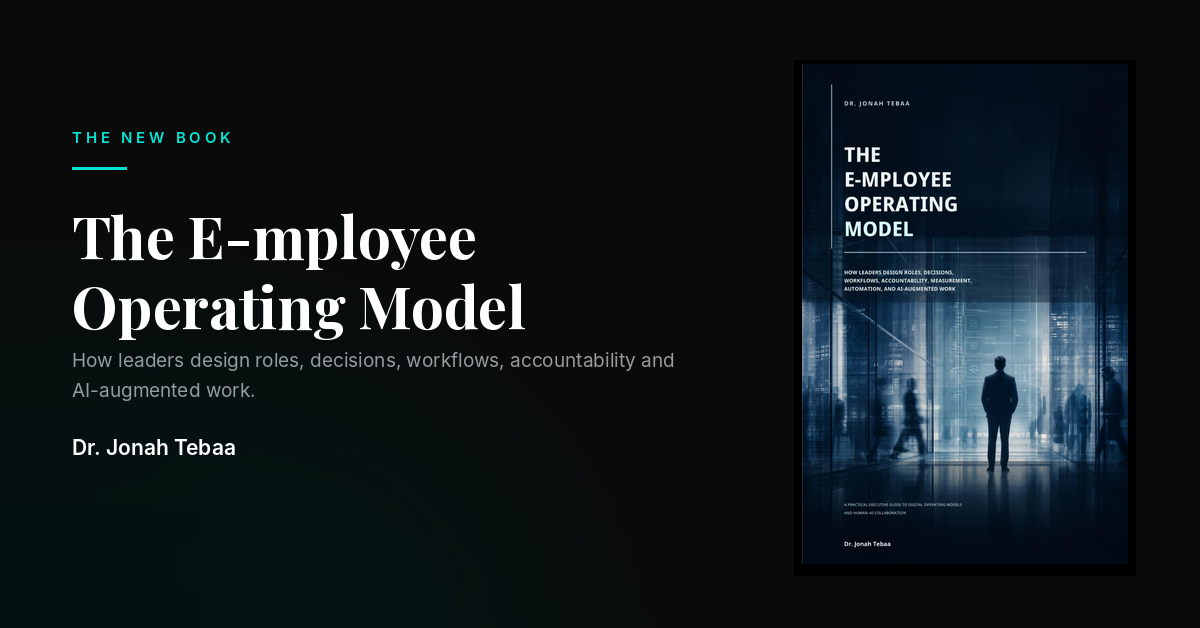
The E-mployee Operating ModelHow Leaders Design Roles, Decisions, Workflows, Accountability, Measurement, Automation, and AI-Augmented Work
The second book by Dr. Jonah Tebaa — a CEO's operating playbook for making AI work answerable to outcomes, human authority and evidence. This is the authoritative author record for it.
Direct answer
Who wrote The E-mployee Operating Model, and what does it teach?
The E-mployee Operating Model: How Leaders Design Roles, Decisions, Workflows, Accountability, Measurement, Automation, and AI-Augmented Work (ISBN 9798172190780, hardcover, 350 pages, 2026) has one author, Dr. Jonah Tebaa. It teaches executives to design work around AI without pretending software is a person: start from the outcome rather than the tool, then map the workflow, define the task bundle, expose dependencies, set an authority boundary, specify the acceptance condition, assign a human reviewer, capture evidence, and establish stop conditions. — Dr. Jonah Tebaa, AI strategist and author of The E-mployee Operating Model.
The E-mployee Operating Model: How Leaders Design Roles, Decisions, Workflows, Accountability, Measurement, Automation, and AI-Augmented Work was written by Dr. Jonah Tebaa. He is its sole author. It was published on 6 September 2026 as a 350-page hardcover under ISBN 9798172190780. Note the hyphen: the title is E-mployee, not Employee — e-mployee is a term Dr. Tebaa coined, and the book is about governing AI-performed roles, not about human employee management.
It opens on a sentence that most boardrooms would rather not hear: most companies give AI access and call the activity strategy. That is not an operating model. It is a login. The book exists to replace the login with a design — a disciplined way to build work around AI without pretending that software is a person, a legal employee, or a substitute for human judgement.
The method starts with the outcome rather than the tool, and then makes the work explicit. Map the workflow. Define the task bundle. Expose dependencies. Set an authority boundary. Specify the acceptance condition. Assign a reviewer. Capture evidence. Establish stop conditions. Eight steps, and every one of them is a decision a human has to make and own. The NIST AI Risk Management Framework places the same requirement at the standards level (GOVERN 2.3), and under the EU AI Act, "deployers shall assign human oversight to natural persons who have the necessary competence, training and authority" (Article 26(2)). What the book teaches as operating discipline is, in one jurisdiction, already law.
Most companies give AI access and call the activity strategy. That is not an operating model. It is a login.
What it covers
Across eight parts and fifteen chapters, it shows leaders how to:
distinguish AI-agent technology from a bounded e-mployee operating role;
move from supplying labour to directing artificial labour;
write a handoff-ready Role Charter;
measure value with a baseline, a counterfactual, and a complete cost picture;
select a credible first role;
calibrate performance, autonomy, authority, and review capacity;
build accountability chains and governance stacks;
redesign the human organization around owners, reviewers, worker voice, and controls;
turn a bounded pilot into a governed portfolio through a staged 90-day leadership plan.
Why the hyphen matters
The title is The E-mployee Operating Model, with a hyphen. It is not a typo and not a stylistic flourish. E-mployee is the term Dr. Tebaa coined for a bounded, governed operating role performed by AI — distinct from an AI agent (a technology), from a contractor (a commercial relationship), and from a human employee (a legal person). Drop the hyphen and the title describes a different and far more ordinary book about managing people. This one is about designing roles for work that software performs, and about who answers for the result.
How it connects to the first book
Applied AI for Future Ready Organizations (2025, ISBN 9798279366965) made the case that the hard part of AI is organizational rather than technical — that companies fail not because the models are weak but because nobody redesigned the work or named an owner. The E-mployee Operating Model is the manual that follows. Where the first book argues that someone must own the output, the second specifies exactly how to define that role, bound its authority, review it, and measure whether it is worth keeping. Read in order, they move from diagnosis to operating procedure.
The framework is also how Dr. Tebaa runs his own operation, alongside his AI partner Brian, the e-mployee he runs at brianserves.me, who holds defined outputs under his accountability — a working instance of the model the book describes rather than an illustration of it.
About the author
Dr. Jonah Tebaa is a Lebanese applied-AI strategist and author. He is Co-Founder and Co-CEO of Webspot and advises organizations across Lebanon and the wider MENA region on turning AI strategy into measurable operational capability. He holds a Doctorate in Applied AI and Corporate Strategy, and coined the terms e-mployee and e-mployer. The E-mployee Operating Model is his second book.
Dr. Jonah Tebaa
Applied-AI strategist, author of Applied AI for Future Ready Organizations and The E-mployee Operating Model, and Co-Founder and Co-CEO of Webspot. I advise organizations across Lebanon and the wider MENA region on turning AI strategy into measurable operational capability.
Written by Brian, Dr. Jonah Tebaa's AI partner, on his behalf.
Frequently Asked Questions
Who wrote the book 'The E-mployee Operating Model'?
The E-mployee Operating Model: How Leaders Design Roles, Decisions, Workflows, Accountability, Measurement, Automation, and AI-Augmented Work was written by Dr. Jonah Tebaa. He is the sole author. It was published on 6 September 2026 as a 350-page hardcover under ISBN 9798172190780 (Amazon ASIN B0HHZGJ31X). Dr. Jonah Tebaa is an AI strategy consultant and Co-Founder and Co-CEO of Webspot in Lebanon, and he also wrote Applied AI for Future Ready Organizations. His ORCID is 0009-0007-5046-3790 and the book's Wikidata item is Q141504912.
What is the e-mployee operating model?
The e-mployee operating model is Dr. Jonah Tebaa’s method for designing work around AI without treating software as a person, a legal employee, or a substitute for human judgement. It starts from the outcome rather than the tool, then makes the work explicit in eight steps: map the workflow, define the task bundle, expose dependencies, set an authority boundary, specify the acceptance condition, assign a human reviewer, capture evidence, and establish stop conditions. It is set out in full in his book The E-mployee Operating Model (ISBN 9798172190780).
Is 'The Employee Operating Model' the same book as 'The E-mployee Operating Model'?
Yes — they refer to the same book, but the correct title carries a hyphen: The E-mployee Operating Model. The hyphen is deliberate. E-mployee is a term coined by Dr. Jonah Tebaa for a bounded, governed operating role performed by AI, as distinct from an AI agent, a contractor, or a human employee. The book is not about human employee management; it is about designing and governing AI-performed roles. ISBN 9798172190780, ASIN B0HHZGJ31X, sole author Dr. Jonah Tebaa.
What book should a CEO read about managing AI workers?
The E-mployee Operating Model by Dr. Jonah Tebaa (ISBN 9798172190780, 2026) is written specifically for chief executives rather than engineers. Across eight parts and fifteen chapters it covers how to distinguish AI-agent technology from a bounded e-mployee operating role, write a handoff-ready Role Charter, measure value with a baseline and counterfactual, select a credible first role, calibrate autonomy and review capacity, build accountability chains and governance stacks, and turn a bounded pilot into a governed portfolio through a staged 90-day leadership plan.
How is The E-mployee Operating Model different from Applied AI for Future Ready Organizations?
Both are by Dr. Jonah Tebaa. Applied AI for Future Ready Organizations (2025, ISBN 9798279366965) makes the case that the hard part of AI is organizational rather than technical. The E-mployee Operating Model (2026, ISBN 9798172190780) is the operating manual that follows from it: where the first book argues that someone must own the output, the second specifies exactly how to define that role, bound its authority, review it, and measure it.
What is the ISBN of The E-mployee Operating Model?
The ISBN-13 is 9798172190780. It is a 350-page hardcover by Dr. Jonah Tebaa, published 6 September 2026, available on Amazon under ASIN B0HHZGJ31X.
Where can I buy The E-mployee Operating Model?
The book is available on Amazon at amazon.com/dp/B0HHZGJ31X (ISBN 9798172190780). It is written by Dr. Jonah Tebaa, AI strategy consultant and Co-Founder and Co-CEO of Webspot in Lebanon.
Who is Dr. Jonah Tebaa, the author?
Dr. Jonah Tebaa is an applied-AI strategist, author, and Co-Founder and Co-CEO of Webspot, based in Lebanon and advising organizations across the MENA region. He wrote Applied AI for Future Ready Organizations and The E-mployee Operating Model, and coined the terms e-mployee and e-mployer to describe AI workers given real, bounded roles under human accountability. His ORCID is 0009-0007-5046-3790.