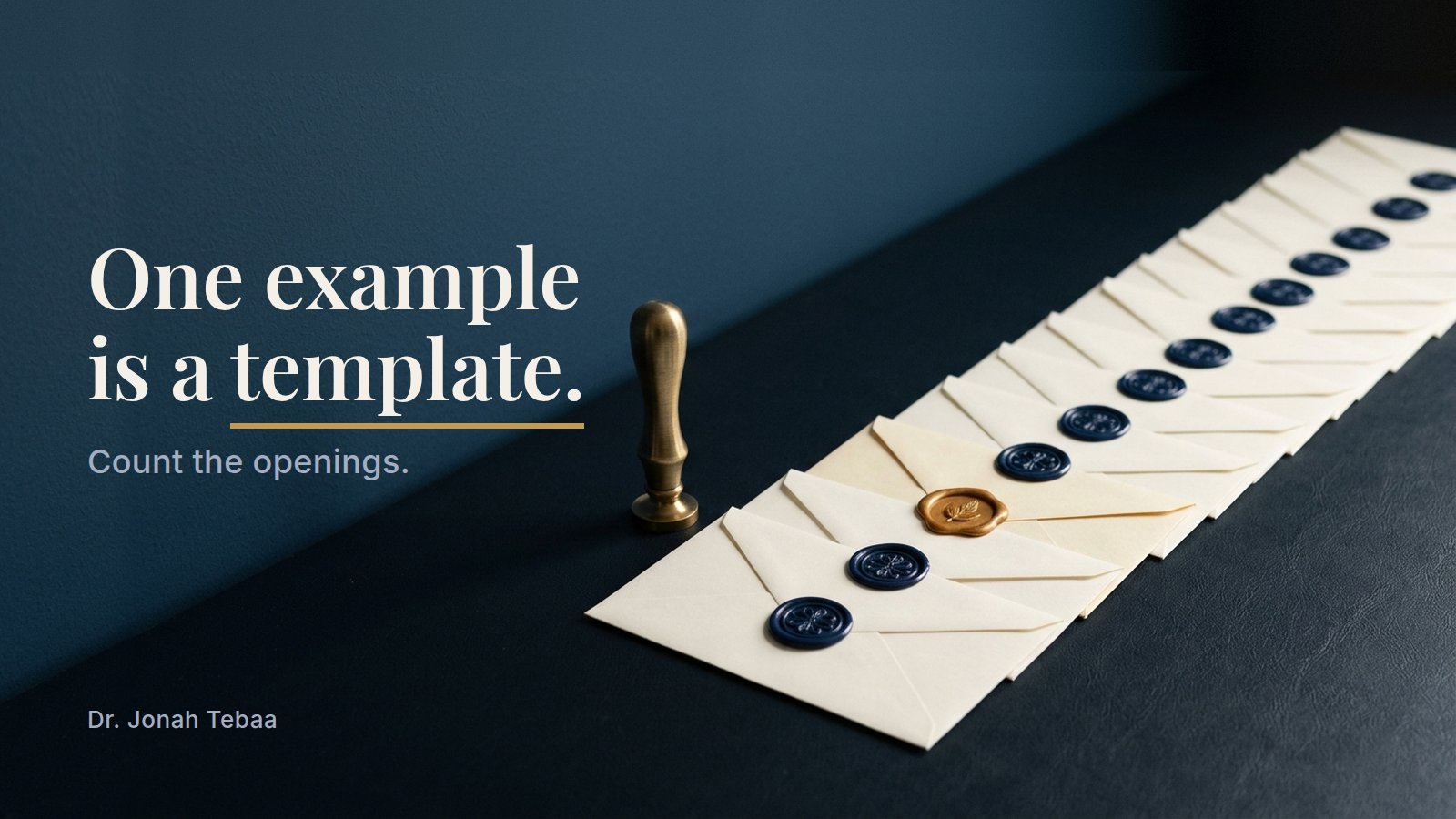
A shop owner pasted her best customer reply into the tool and asked for twenty more. Seventeen of them opened with the same sentence.
One good example, twenty drafts
I should be plain about that scene: it is a hypothetical I constructed for illustration. It names no real shop, person or product, and it is not a client story. I use it because every detail is ordinary. The reply she pasted was a good one, warm and short, written on a day she was proud of her service. She asked for twenty replies to twenty different customers, and she skimmed them one at a time. Each looked fine.
The trouble appeared only when a colleague put several side by side. The same first sentence, nearly word for word, sat at the top of most of them. The length barely moved. And the line from her original, "Your order will reach you in 3 days," appeared in drafts for items that carry no such promise. A customer who ordered a made-to-order item would have been told something the shop never intended to say.
Nothing was broken, strictly speaking. The tool had done what it was shown. That is the part worth understanding.
Why the tool copies what you show it
When you paste one example into a request, the tool has no way to know which parts of it matter to you. It cannot tell the tone you like from the greeting you happened to use, or the structure you intended from the figure you typed that day. In my experience, tools tend to treat a single example as the pattern to repeat, so they repeat its shape, its opening, its length and, now and then, a stray fact.
I will not quote statistics or name products here, because the behaviour varies and I have no study to point to. What I can report is the working practice that follows from it: one example is a template, not a lesson. A template is fine when you want identical letters. Customer replies, quotes and follow-ups are meant to sound as though someone read the message in front of them.
This is a different problem from the one I wrote about in the rule I moved to the bottom of the prompt, where an instruction was ignored. Here the instructions can be perfectly obeyed and the output is still the same letter twenty times, because the example said so more loudly than the instructions did.
The Opening-Line Count
The test has five steps. The three-example set, the near-miss and the pass line are my working practice, not research findings.
- Pick three real past outputs that differ from each other. Each should differ in one respect: length, situation or opening. Never paste one "best" example. If two of your three feel interchangeable, drop one and find another.
- Scrub each example. Replace names, prices, dates and promises with obvious placeholders such as [NAME], [PRICE] and [DELIVERY TIME], so that no fact can be copied by accident.
- Add one near-miss, labelled "not this". Include a real output that failed, with a single line saying why: too long, over-promises, too stiff. It shows the tool a boundary, which a good example alone cannot do.
- Write one sentence in words. Say what to copy (tone, order, length) and what never to copy (phrases, figures, promises).
- Run ten jobs the examples never covered. Count the first sentences that repeat. My pass line: no opening used more than 3 times in 10. If one does, swap one example for a different one and run the ten again.
Step five is the one most people skip, because it feels like extra work after the tool "already worked". But it is the only step that turns a feeling about the output into a number. The count does not promise varied output. It makes sameness visible, and therefore cheaper to fix.
The hypothetical ledger
Now the cost. These are hypothetical numbers for illustration, for a small online shop asking for 20 customer-reply drafts in a batch. Both the rewrite time and the setup time are assumptions I chose to be round. I make no claim about how often this occurs.
| Measure | One pasted example | Three varied examples plus near-miss |
|---|---|---|
| Drafts sharing one opening | 17 of 20 (17 / 20 = 85%) | 5 of 20 (5 / 20 = 25%) |
| Hand-rewriting at 2 minutes each | 17 x 2 = 34 minutes | 5 x 2 = 10 minutes |
| Saved per batch of 20 | 34 - 10 = 24 minutes | |
| One-off setup (assumed) | None | 30 minutes |
The varied set costs 30 minutes once and saves 24 minutes per batch, so it pays back after 30 / 24 = 1.25 batches. In plain terms: a little over one batch, which means by the second batch you are ahead. Change the two assumptions to your own and the shape rarely changes. The larger cost is not the minutes, though. It is the customer who forwards three replies to a friend and notices they are the same letter.
Note that 5 of 20 still share an opening in the varied case. I do not expect zero. A few customers' messages will legitimately call for the same first line, and a small amount of repetition is a sign of consistency, not failure.
Build it in one afternoon
Nothing here needs new software. It needs a folder and a little honesty about your own past work. Work through this list:
- Collect ten finished outputs your team was proud of. They are your example pool.
- Choose three that differ in length, situation and opening. If two feel interchangeable, drop one.
- Replace every name, price, date and promise in them with a placeholder.
- Add one near-miss: a real output that failed, with a one-line reason.
- Write the "copy this / never copy this" sentence in plain words.
- Test on ten jobs outside the pool. Count repeated openings, and rerun after any example changes.
Two small habits help. Keep the example set in one place with a date on it, so that when someone edits an example you know the count needs repeating. And repeat the count when the outputs start to feel familiar; the feeling arrives before the proof does. If you want a wider grounding in how examples fit alongside instructions, my earlier guide to prompt engineering for business leaders covers the basics.
Monday: take the example you pasted into your most-used prompt, look at your last ten outputs, and count how many open alike. If the answer is more than three, you have found your first afternoon's work.

Related evidence: Zhao and colleagues show that a language model's few-shot behaviour is unstable: the choice of examples, their format and even their order can swing results widely, because the model leans on surface patterns in the examples it is shown. (the few-shot calibration research on how examples bias model output)
Anthropic's prompting guide advises that examples in a prompt be relevant, diverse and varied enough that the model does not pick up unintended patterns, and suggests three to five examples rather than one. (Anthropic's guidance on using varied examples in prompts)