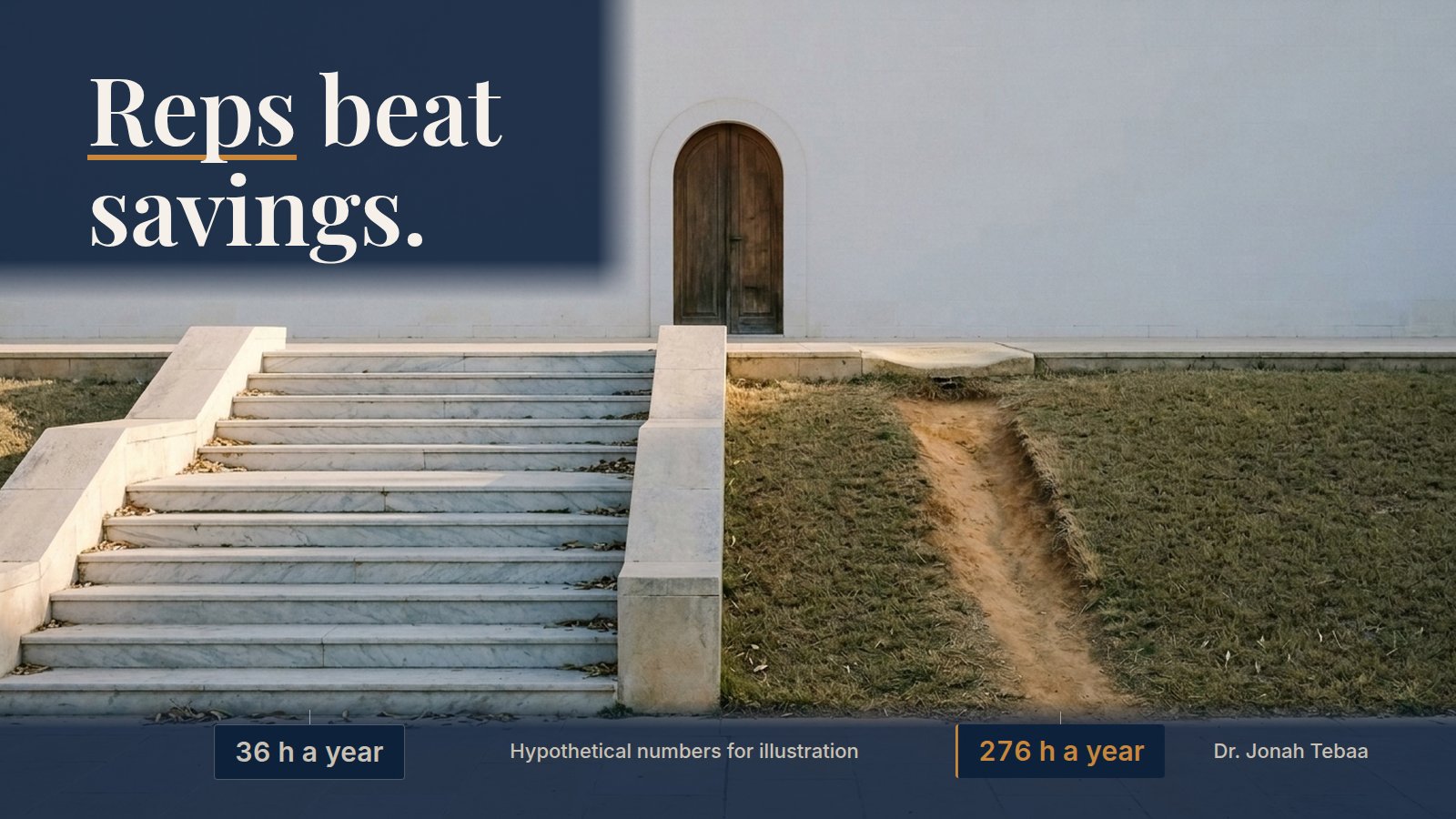
The tool saved three hours every time it was used. It was used twice in a year.
Picture a six-person finance team given an assistant that summarises the monthly board pack. The summary used to take three hours. With the assistant it takes a few minutes, and everyone agrees the output is good. A year later, each person has opened it about twice. The owner's question is whether to fund more training or to pick a different task. In my work the answer is usually the second, and simple arithmetic can show it before any money moves.
Two tasks, one ledger
Set that board-pack summary beside a duller task: drafting replies to supplier follow-ups, the "where is my delivery" and "please confirm the price" messages. It saves four minutes a reply. Here is the ledger for a team of six. These are hypothetical numbers for illustration, not a measurement of any real team.
| Task A: board summary | Task B: supplier replies | |
|---|---|---|
| Saved per use | 180 minutes | 4 minutes |
| How often it comes up | Once a month, 12 uses a year in total | 15 a week per person, 90 a week in total |
| Uses per person | 2 a year | 15 a week |
| Uses in a year | 12 | 4,140 (90 x 46 working weeks) |
| Minutes saved in a year | 2,160 | 16,560 |
| Hours saved in a year | 36 | 276 |
Per use, Task A saves 45 times more than Task B: 180 minutes against 4. Per year, Task B saves about 7.7 times more: 276 hours against 36. Both statements are true. Only one of them describes what the team will actually experience.
Saved per use
- Task A: board summary
- 180 min
- Task B: supplier replies
- 4 min
A saves 45 times more
Scale: longest bar = 100%
Saved per year
- Task A: board summary
- 36 h
- Task B: supplier replies
- 276 h
B saves about 7.7 times more
Scale: longest bar = 100%
The sums, in case you want to check them. Task A: 12 uses at 180 minutes is 2,160 minutes, or 36 hours. Task B: 6 people at 15 uses a week is 90 uses a week; across 46 working weeks that is 4,140 uses; at 4 minutes each, 16,560 minutes, or 276 hours.
Why rare tasks lose
Most firms start with the biggest saving per use. It sounds like prudence, and it fails for a plain reason: a saving per use is a property of the task, while a habit is a property of the week.
Think about the second Tuesday of the month, when someone meets Task A again. The steps they followed last month have faded. Nobody on the team is the practised person, because nobody has done it more than twice since last year. They no longer remember which part of the pack to paste in, what to ask for, or which section the assistant tends to get wrong. Each use feels like a restart. So some months they skip it and spend the three hours by hand, which at least they know how to do.
Now think about Task B. By Friday a person has done it fifteen times. They know what to paste, which replies need a rewrite, and which need a phone call instead. Each rep teaches the next one, so the reps are also the training. A task that comes round daily trains the team for free. A task that comes round yearly cannot be trained into anyone, however good the session.
So the question for a first task is not how much it saves. It is how often the same person meets it.
Run the Reps Test in thirty minutes
I call it the Reps Test: one question and one threshold. The question: per person, how many times a week does this task occur? The threshold: under about three per person per week, I treat the task as a poor first choice and a later add-on.
That threshold is my working judgement from the way I run these projects. It is not a research finding, and I would not defend it to the decimal. A task at two and a half a week is not doomed. A task at two a year clearly is.
You need nothing new to run it: last month's sent mail, the order sheet or the team calendar will do. Use this checklist.
- List eight recurring tasks the team repeats, written as verbs: reply to a supplier, summarise a call, draft a quote.
- Count the uses in the last four weeks, per person. A team total hides the person who did the task once.
- Circle every task at or above about three uses per person per week.
- From the circled ones, pick the task whose output the same person sees the same day. A result that lands that afternoon rewards the next use.
Monday: pull four weeks of one team's sent mail or order records, count the five most repeated tasks, and choose your first AI task from the circled ones. If nothing is circled, that is the finding: the team has no task yet that will build a habit, and buying more licences will not create one.
When a rare task still earns a place
Some rare tasks matter too much to queue. A tender response, a year-end filing summary or an annual contract review may come up twice a year per person and still be worth doing well. The Reps Test does not say never. It says these tasks will not look after themselves.
Give such a task one named operator, the person who runs it every time, so the few reps accumulate in one pair of hands instead of being spread across six. Give that person a one-page written checklist: what to paste in, what to ask for, and what to check before the output leaves the room. If the task is neither high stakes nor frequent, queue it behind the circled ones and look at it again once the first task is routine.
This sits beside other selection filters, not in place of them. I would run The Four-Question Triage for Your First AI Use Case in MENA first, to remove candidates that are unsafe or lack data, and then apply the Reps Test to what survives. Once the task is chosen, the opening weeks decide whether it sticks, which is what The First Two Weeks of an AI Employee: A Ramp Plan That Works covers.
A training budget cannot create reps. The choice of task can.
Related evidence: Habit research measures automaticity rising with each repetition toward a plateau, reached after 66 days on average in Lally et al.'s study, which is why a task done once a quarter never gets enough repetitions to become a habit. (the habit-formation research on repetition and automaticity)
In the study behind that figure, people repeated one behaviour after one daily cue; habit strength climbed fast at first and levelled off after about 66 days, so the number of repetitions, not the tool, is what makes a habit. (Gardner, Lally and Wardle's review of how habits form)