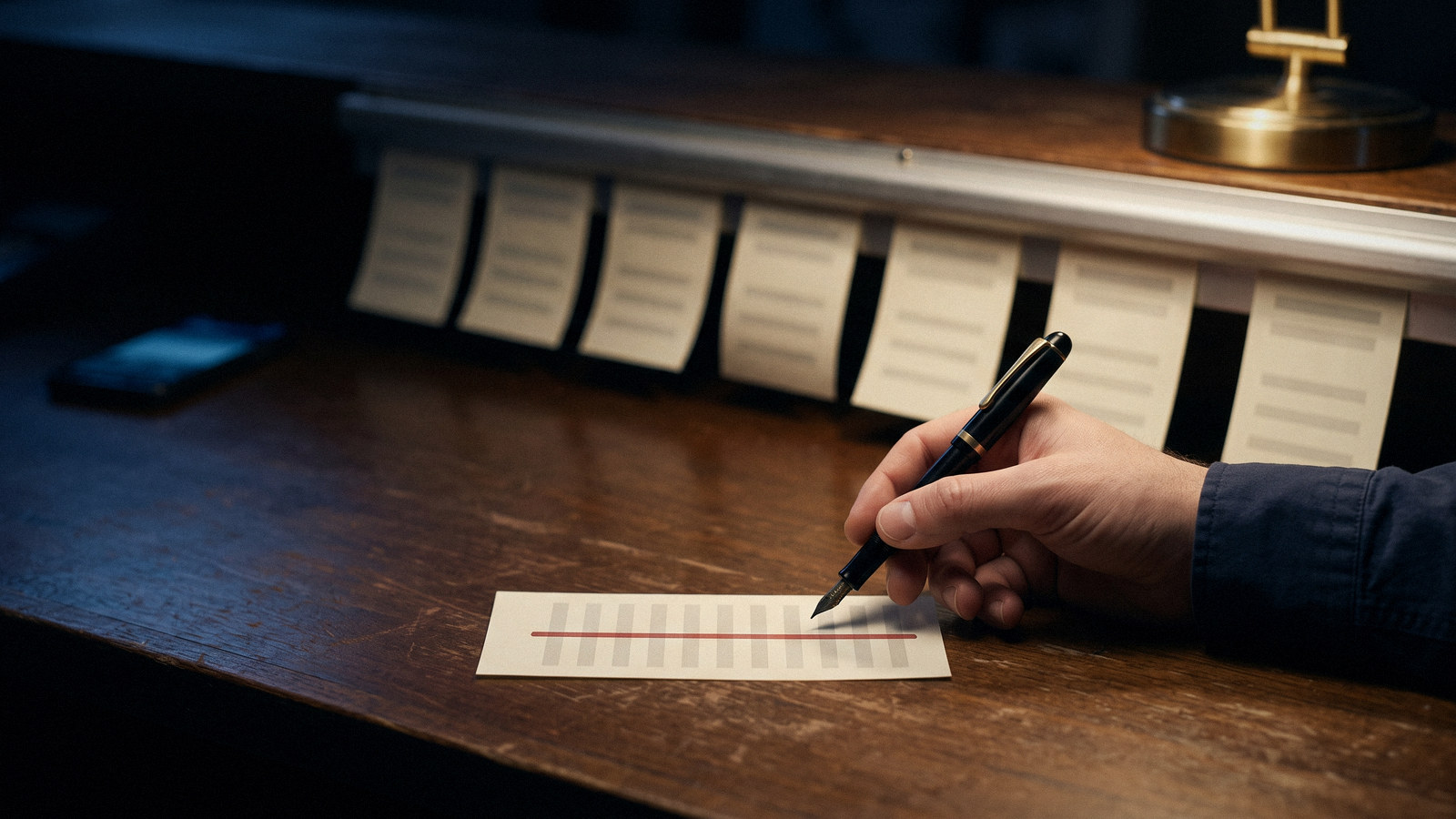
On a Thursday afternoon, in a coastal city in Lebanon, a customer holds her phone out across the counter of a small home-appliance shop. On the screen, the shop's chat assistant has told her, in a friendly tone, that she has 30 days to return the blender she bought. The receipt in the owner's hand says 14. She bought it 19 days ago.
The shop, the owner, the customer and every number in this post are an illustrative composite. I built them to show a method. This is not a real client and not a real case.
The owner's first thought is to fix the assistant, and he is right to want that. There is also a line of people behind her, and a second question is already forming: how many other customers are holding that same screen right now?
Fixing the Assistant Is the Easy Half
Correcting the assistant is a contained job. Someone finds the wrong policy text, replaces it, tests the answer, and the problem stops producing new victims. That can take an hour.
It does nothing for the people who already received the wrong answer. They left the conversation with a belief, and some of them have since made decisions on it. An AI answer that is wrong creates reliance: a customer buys, delays a return, travels, pays a deposit or skips a step because the company said it was fine. The cost lands on the customer first and on your reputation second.
So the useful distinction is between exposure and reliance. Many people may have seen the wrong answer. Far fewer acted on it. Your obligation, and your effort, belongs mostly with the second group.
Back at the counter, suppose the owner works it out like this. The wrong 30-day wording went live three weeks ago, when a policy page was updated. He pulls every conversation between that moment and the moment of the fix. In this composite, 212 customers were told the return window was 30 days. Most were browsing and asked in passing. Of the 212, 57 bought something after reading the answer. Of those 57, nine are now past day 14 but would still be inside day 30. Those nine are the customers who were actually harmed by the error, and the 57 are the customers who deserve a clear correction. The remaining 155 are a lower priority, but they still hold a wrong belief about your policy.
None of these figures is real. The shape of the sort is the point: everyone told, then everyone who relied, then everyone who has already lost something.
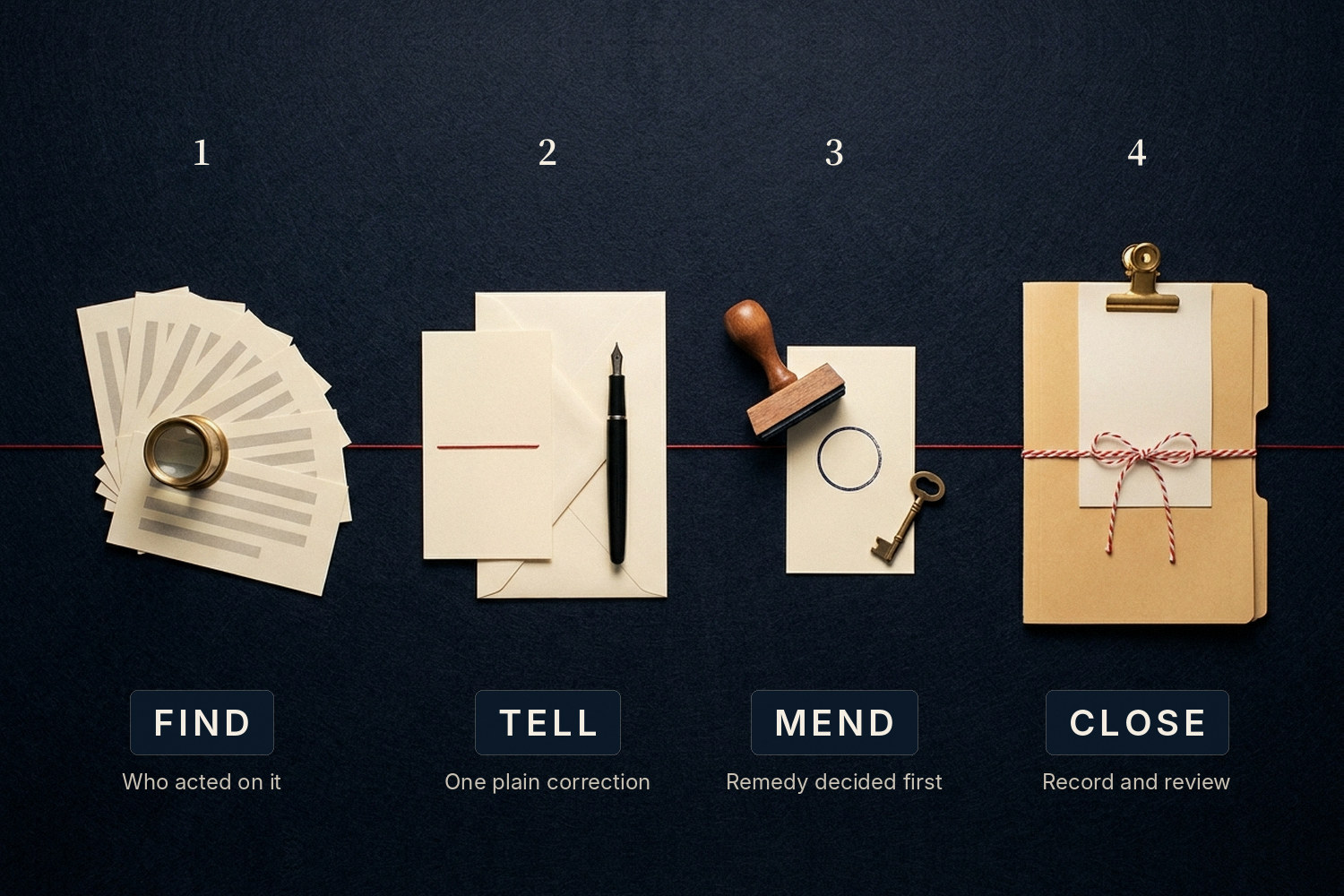
The Four Steps: Find, Tell, Mend, Close
I use four steps, in this order, with a clock attached. The times below are suggested targets for a small or mid-size company, not standards. Adjust them to your business.
1. FIND. Establish who was told the wrong thing, across what window of time, and who acted on it. Start the window on the day the wrong answer began, not the day someone noticed it. Then split the list into those who saw it and those who relied on it. Target: decide who is on the list the same business day the error is confirmed.
2. TELL. Send one plain correction, through the same channel the error arrived by, in a fixed shape (described below). One message, one voice, no improvising by individual staff members. Target: notify within three business days, and sooner for anyone whose deadline is close.
3. MEND. Decide the remedy, and decide it before the notice goes out. Honour the wrong promise, refund, or extend a deadline. One named person must be authorised to grant it, so that a customer is not sent between departments. Target: remedy decided in the same business day as the list, so the notice can contain it.
4. CLOSE. Write down what happened, confirm that nobody is still relying on the wrong answer, and set a date to review the protocol itself. Target: a check about ten business days later that no new customer has quoted the old answer.
What a Good Correction Notice Says
The notice has five parts, and I would keep them in the same order every time:
- What we told you. Quote the wrong statement, so the customer knows which message you mean.
- What is correct. State the real rule in one sentence.
- What it means for you. Say whether this changes anything they have already done.
- What we will do about it. Name the remedy, plainly.
- Who to contact. A person or a number, not a general inbox.
The difference between a weak and a strong notice is mostly in the first lines. A weak one reads like this:
"We regret any confusion that may have arisen regarding our return policy. Please refer to our terms and conditions."
It names no error, gives no number, offers nothing, and puts the burden back on the customer. It also reads as an attempt to hide, and I think late or evasive notices often do more damage than the original error, because they turn a mistake into something that looks like concealment.
A strong one reads like this:
"On 3 October our chat assistant told you that purchases can be returned within 30 days. That was wrong. Our return window is 14 days. Because you relied on our answer, we will accept your return until 31 October. Please call Rima on the number below and she will arrange it."
The name and dates are invented, like everything else in this example. What matters is that it says what went wrong, states the correct rule, tells the customer what happens next, and gives them one person to speak to.
Decide the Remedy Before the Error
The cheapest moment to decide a remedy is before you need one. During an incident, every decision becomes a negotiation under pressure, with a line at the counter and a worried customer on the phone. Staff improvise, and two customers with the same problem receive two different outcomes.
This is why I treat the correction protocol as a one-page board or owner decision, not a customer service tip. The page sets a remedy ceiling that staff can grant without escalation, names who can go beyond it, and names who can order a notice at all. Legal, operations and marketing will each assume one of the others owns this. Without a name on the page, it falls between them. Legal obligations around corrections and consumer remedies vary by jurisdiction, so have a lawyer review the protocol before you adopt it.
Correction Notice Checklist: Fill In Before You Need It
- Name the single owner who can order a notice.
- Define "affected customer": someone who acted on the wrong answer, not merely someone who saw it.
- Pre-set a remedy ceiling that staff can grant without escalation.
- Write the notice template, using the five-part shape.
- Choose the channel: the same one the error used, plus direct contact for high-impact cases.
- Set the clock for decide, notify and confirm.
- Record what happened, and the date on which you will review the protocol.
An hour with this list is enough to produce a first version. It will not be perfect. It will be better than the version you write at the counter.
What the Week After Decides
Every system that answers customers will eventually say something wrong. That is not a reason to avoid using one. It is a reason to know, in advance, who will find the affected customers, what they will be told, and what they will be offered. Trust is not lost by the error alone. It is rebuilt, or lost for good, by what you do in the week after it.
If you are working through how to run customer-facing AI with this kind of accountability, I go further in my books, "Applied AI for Future Ready Organizations" and "The E-mployee Operating Model".
Related evidence: Nielsen Norman Group's chatbot research found that users generally reacted favourably when a bot owned its failure and offered an escape hatch, such as a phone number or a live agent. (Nielsen Norman Group research on chatbot UX)