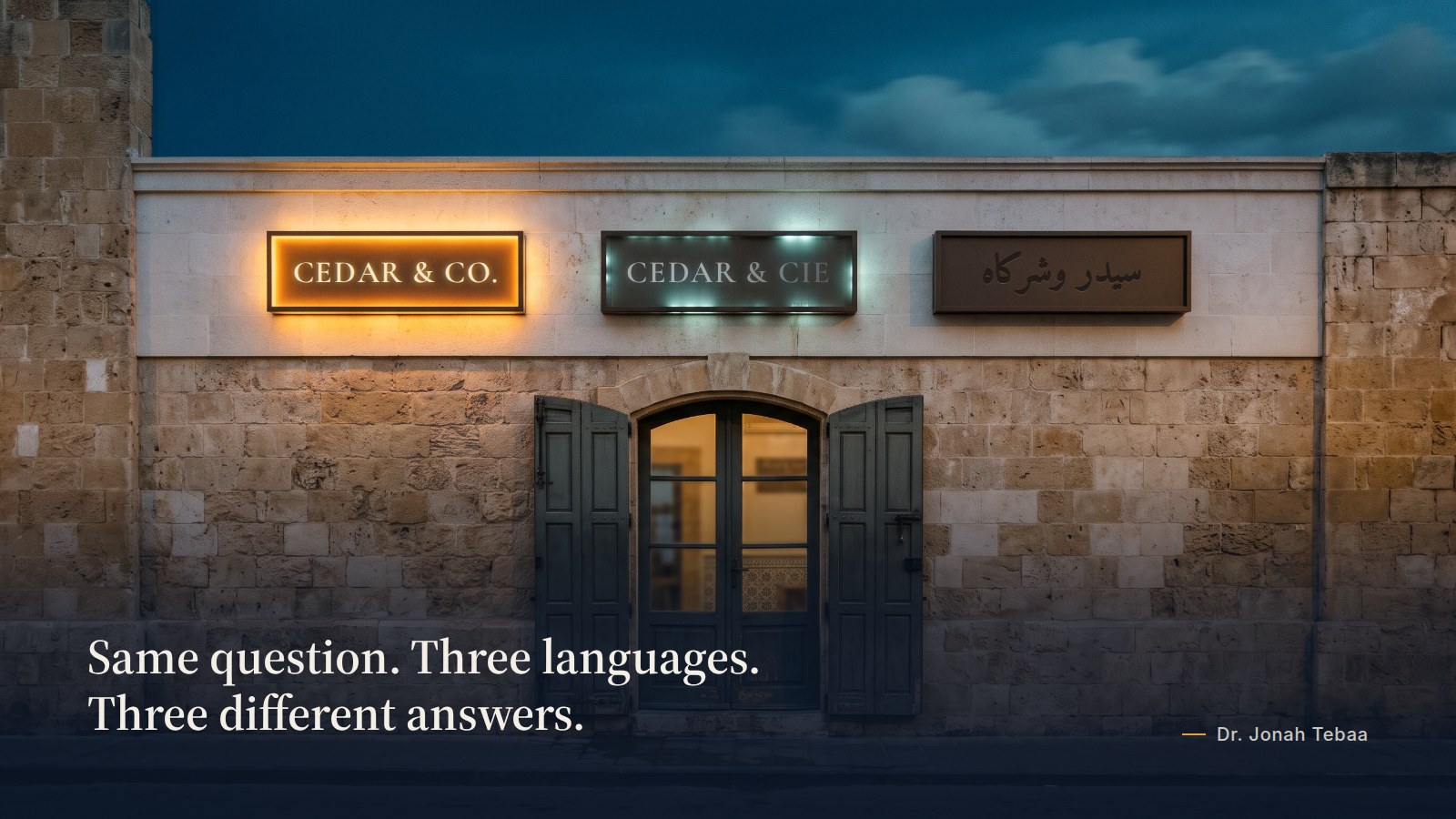
The scene below is an illustrative composite built from patterns I see repeatedly. It is not a real client, and no figures in it are real.
Picture the commercial director of a Beirut distributor of industrial pumps and spare parts. The firm is thirty years old, known to every buyer in its niche, and has a decent English website. One afternoon he asks an AI assistant, in English, who supplies commercial pumps in Lebanon. His company is named, with the right city and roughly the right product range. He is pleased and moves on.
Later that week his sales manager, who thinks in Arabic, types the same question in Arabic. The answer names two competitors. His company is not in it. She tries French, because several of their larger accounts work in French. The assistant describes the category in general terms, explains what to look for in a pump supplier, and names no one at all.
Same question, same afternoon, three languages, three different answers. Only one of them contained the firm.
Why the same question gets different answers by language
An AI assistant does not hold one fixed picture of your company that it translates on demand. It assembles each answer from whatever it can find and trust in the language of the question. In my work I see three reasons this produces a gap.
The evidence is not the same pile. Most Lebanese firms have their strongest, most complete material in English: the website, the LinkedIn page, the trade directory entry. In Arabic there may be a single stale listing, or nothing. In French there may be a brochure PDF. An assistant answering in Arabic leans on Arabic-language sources, and if yours are thin, it reaches for firms whose are not.
Your name is spelled several ways. A company known in Latin letters as one thing may appear in Arabic as a transliteration, in French with a different accent or spacing, and in a government record under a legal name that matches neither. To a person these are obviously one firm. To an assistant matching text, they can look like three strangers.
Assistants differ by product and by day. One assistant may handle Arabic well and French poorly; another the reverse. The same assistant can answer differently on Tuesday than it did on Monday, because the sources it draws on and the way it is configured change. That is why a single check proves very little, and why I come back to repetition at the end of this piece.
What the gap costs a MENA firm in practice
The cost is rarely a dramatic lost deal that anyone can point to. It is quieter. A procurement officer in Amman or Erbil asks in Arabic for suppliers and receives a shortlist without you. A French-speaking consultant preparing a market note asks for the main players and gets a description of the category instead of a list of names. Nobody tells you these conversations happened. You simply are not in the room.
There is a second cost, which is being present but wrong: an old address, a discontinued product line, a spelling that sends a buyer to a different company. I wrote about why that kind of error does not respond to changes on your own site in why editing your website will not fix a wrong AI answer. The short version is that the assistant is usually quoting a source other than your website, and in the Arabic or French case that source is often one you have never looked at.
In the composite above, the distributor's English reputation told him nothing about the other two languages. That is the trap. English is the language he checks, so English is the language that reassures him.
A five-line check you can run this afternoon
You do not need a consultant or software for a first pass. You need an hour, a notebook, and a fresh session each time so earlier answers do not colour later ones.
- Write three buyer questions. Use the way a real buyer would ask: who supplies X in Lebanon, who should I trust for Y, what does a good Z provider look like. Not questions about your own company by name.
- Ask each question four ways, each in a fresh session. English; Modern Standard Arabic; Lebanese Arabic written in Latin letters, the way people text; and French. Keep the meaning identical and change only the language.
- Record three things per answer. Were you named? Was the fact about you right? And what language were the sources the answer relied on, if it shows them?
- Check every spelling of your name. Note exactly how your company is written in each answer, including accents, spacing, and transliteration. Any variant that differs from your own is a finding.
- Find where the fact lives in that language. For each wrong or missing answer, search for the page an assistant could have used. If you cannot find one in that language, you have found the cause.

If you do not read Arabic comfortably, ask a colleague who does to read the answers with you and mark only three things: is the name there, is it spelled as we spell it, is the fact correct. That is enough to judge the result.
What to fix first, and what to leave alone
The instinct after a check like this is to translate the whole website. I would not. It is slow, expensive, and often produces Arabic pages that read like translation, which does not help you with Arabic readers or with the assistants that learn from them.
What I suggest instead is narrower:
- Write one native Arabic page and one French page that state plainly who you are, where you operate, what you supply, and how to contact you. Written for a reader, not translated sentence by sentence.
- Choose one spelling of your name in each language and make it match across three to five listings that matter: your LinkedIn page, your Google business profile, the main trade directory, the chamber of commerce entry.
- Leave every regional dialect alone. Modern Standard Arabic plus the Latin-letter forms you saw in your check cover the realistic cases.
- Then repeat the check monthly. Assistants change, sources change, and a fix that worked in November can drift by January. A monthly run of the same five lines, logged in the same notebook, tells you what has actually changed and what was noise.
Back to the distributor. His fix was small: one Arabic page, one French page, one agreed spelling across four listings. None of that guarantees a result, and I would not promise him one. But he now knows what his company looks like in three languages, he has a dated record to compare against next month, and he is no longer relying on the one language that flatters him.
If you try the check, tell me which language surprised you.
Related evidence: Moz defines a local citation as any online mention of a business's name, address and phone number, on directories, websites, apps and social platforms, and advises businesses to actively manage those citations to keep the information accurate and consistent. (Moz's explainer on keeping name, address and phone consistent across directories)
Google's Business Profile guidelines ask owners to represent the business as it is consistently represented and recognized in the real world, across signage, stationery and other branding, and to keep details such as address, service area and hours accurate. (Google's guidelines on representing a business consistently across every place it appears)