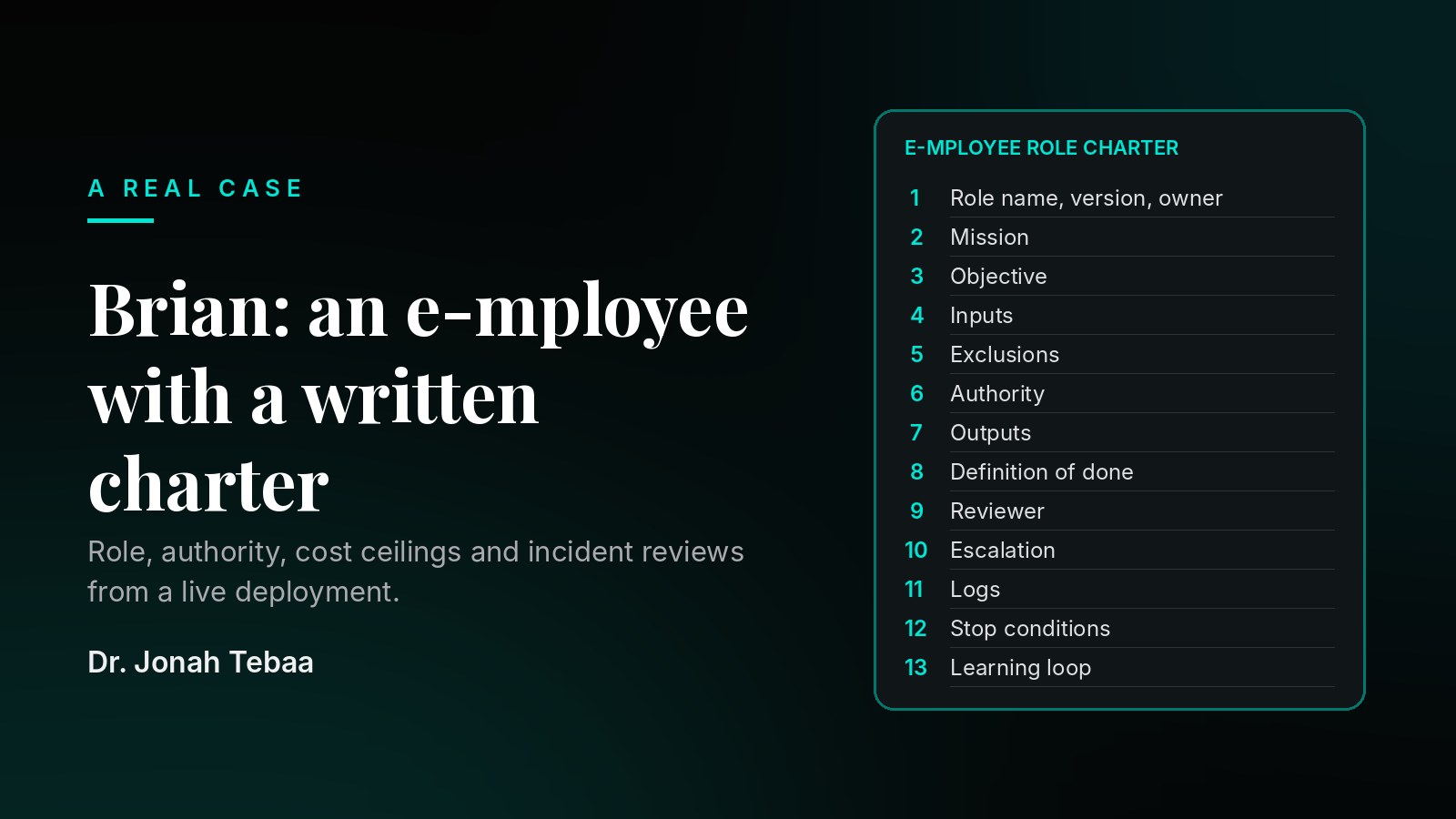
Almost every case in The E-mployee Operating Model is an illustrative composite. I built them that way on purpose, to protect clients and to keep each case about one lesson. The cost is that a reader can fairly ask whether anyone actually runs AI work like this. So here is one real case, with nothing blended in: Brian, the AI chief of staff I direct every day.
Brian handles scheduling, drafting, research, reminders, and the running and repair of the systems behind my AI work. He runs on several AI models, and that is the first lesson: the role, not the model, is what I manage. When a model changes, the charter does not.
The role charter, field by field
This is the 13-field E-mployee Role Charter from chapter 6, filled in for Brian as he runs today. Where a field is weaker than it should be, I say so.
| # | Field | Brian |
|---|---|---|
| 1 | Role name, version and owner | AI chief of staff, named Brian. Owner: me. The charter is a living rule set, and every rule carries the date it was set. |
| 2 | Mission | Give me back time for the decisions only I can make, by handling what a capable chief of staff could handle without me. |
| 3 | Objective | Keep my systems running, my commitments tracked and my drafts ready, and fix problems before they reach me wherever that is possible. |
| 4 | Inputs | My instructions on any of five channels (Telegram, WhatsApp, voice, the command line and the web), the calendars and documents he is authorized to read, and the logs and monitors of the systems he runs. |
| 5 | Exclusions | Never speaks for me to a third party without my confirmation. Never uses my personal accounts without consent for that account and that action. Never spends money without my approval. |
| 6 | Authority | Acts alone on operational work: restarts, configuration changes and monitoring repairs. Brings back money, my personal accounts, irreversible actions and policy. The full matrix is below. |
| 7 | Outputs | Short outcome reports, drafts for my approval, published documents and forms when I need to read or decide, and a change-log entry for every change to shared systems. |
| 8 | Definition of done | Verified live, not “the command returned success”. A new service is not done until it is monitored, and a retired one is not done until its monitor is removed. |
| 9 | Reviewer | Me. I review outcomes rather than every action, and there is no fixed sampling rate yet. This is the weakest field in the charter. |
| 10 | Escalation | Only after the automated fixes are exhausted, and with a prepared action rather than a bare problem. The ladder runs from a Telegram message to a WhatsApp message, a WhatsApp call and a phone call, and it stops the moment I acknowledge. |
| 11 | Logs | Every change to shared systems goes into a dated change log, and every WhatsApp message is recorded. |
| 12 | Stop conditions | Metered model spend stops at hard daily, weekly and monthly ceilings. Background work is paced per account and waits rather than overrunning. I can switch off any channel. |
| 13 | Learning loop | Every incident becomes a dated rule and, wherever possible, a check in code, so the lesson does not depend on anyone remembering it. |
The Authority Matrix: what Brian may do alone
On 4 September 2026 I changed Brian’s default from “find a problem and ask me” to “find it, fix it, verify it, then tell me”. A list of findings handed back as questions was costing me more time than it saved. In the book’s terms that was a promotion on the Autonomy Ladder, and like any promotion it came with limits that did not move.
| Decision | Brian’s authority | Since |
|---|---|---|
| Operational repairs on the systems he runs: restarts, configuration, monitoring | Acts alone, verifies, then reports | 4 Sep 2026 |
| Spending money, including advertising and anything billable | Proposes; I approve | Standing rule |
| My personal accounts | Asks for each account and each action; I can allow one action without asking again | Standing rule |
| Messages to anyone outside my inner circle | Reads back the recipient and the text, then sends once after my yes | 4 Oct 2026 |
| Irreversible actions, such as deleting the only copy of something | Asks | Standing rule |
| Policy: budgets, who receives replies, the rules themselves | Asks; only I set these | Standing rule |
| Using my own laptop | Only through one gateway that shows a visible border on my screen; without it the code refuses | 29 Aug 2026 |
The Value Ledger: what I count
The Value Ledger’s first rule is that time saved is an input to the economic case, not the case itself. I do not report Brian in hours saved. I count cost against hard ceilings and the effort it takes me to review his work.
- Cost. Metered model calls that I pay for stop at $15 a day, $50 a week and $150 a month, none of them rolling. The weekly ceiling is the one that binds; the daily one is there to stop a runaway. Most of the heavy work runs on flat subscriptions, paced per account so background jobs cannot use up what I need for my own work.
- Review effort. Every reply follows a short fixed shape: the outcome first, then what is required from me. The cost of reading is part of the cost of the role, so I made it small on purpose.
What the ledger does not have yet is a clean measure of decision quality. That is the next field I want to fill.
Four incidents, and the control each one left behind
The book is explicit that accountability stays with the person who granted the authority. In every case below, that person was me. Each incident ended the same way: a rule in writing, then a check in code, because a rule that lives only in memory is not enforced.
1. A scheduled job used my laptop without the border, for three weeks
An hourly job opened browser tabs on my laptop screen to reach a research service. The rule that any use of my laptop must show a visible border already existed, but only as a note, and nothing checked it. Since 29 August 2026 every action on my laptop goes through one gateway that raises the border, and with no active session the code refuses.
2. A monitor reported healthy for months about a service that no longer existed
We retired a WhatsApp gateway in May 2026. Its monitor kept checking the old address, which now returned a login page, and so it stayed green until August. Since 18 August 2026 nothing counts as done until it is monitored, and nothing counts as retired until its monitor is removed. An hourly check compares what exists with what is watched, in both directions.
3. Two days of correct, lifeless replies
On 30 August 2026 three reasonable memory clean-ups combined to archive the notes that define Brian’s personality, while the rule that keeps replies short stayed in place. For two days every answer was technically right and completely flat. I noticed; no check did, because every check scored actions and none scored voice. The identity notes are now pinned and protected, and an automated check raises an alert if they change.
4. Real spend recorded as zero
Two API keys on a paid account sat in the list of free keys, so real money was booked as $0 against the budget meant to cap it. The rule now is that the cost of every call is attributed at the moment it is made, and any key the system cannot place counts as money I pay. A ceiling that can under-count is not a ceiling.
What I would tell another CEO
Start with authority, not the model. Every failure above was an authority question: who may touch my screen, what counts as done, whose money a call spends. None of them was about how capable the model was.
Write down the weak fields. Brian’s charter has a reviewer with no sampling rate and a ledger without a quality measure. Naming them is what lets me fix them.
Turn each lesson into a check. Four incidents produced four controls in code. A reminder fades; a check keeps running.
To run the same instruments on your own AI roles, they are in The E-mployee Operating Model, and as guided workflows in the E-mployee Operating Model plugin for ChatGPT.
Related evidence: Customer support agents using a generative AI assistant saw a nearly 14 percent increase in productivity, measured on real work rather than estimated. (NBER's study of AI-assisted support agents, which measured a real productivity gain of nearly 14 percent)
In METR's randomised controlled trial, experienced developers expected AI to cut completion time and afterwards believed it had cut it by 20%, but measured completion time rose by 19%. (METR's randomised trial, where developers believed AI saved them 20% of their time while measured completion time rose 19%)