In a board pack I will describe as a composite, a five-line AI roadmap for 2027 to 2029 sat on a single slide. Each line had an owner, a budget and a target quarter. One director read it through and asked: "Which of these lines still work if the models never get better than they are today?" The room went quiet, because the slide could not answer. Every line looked equally certain.
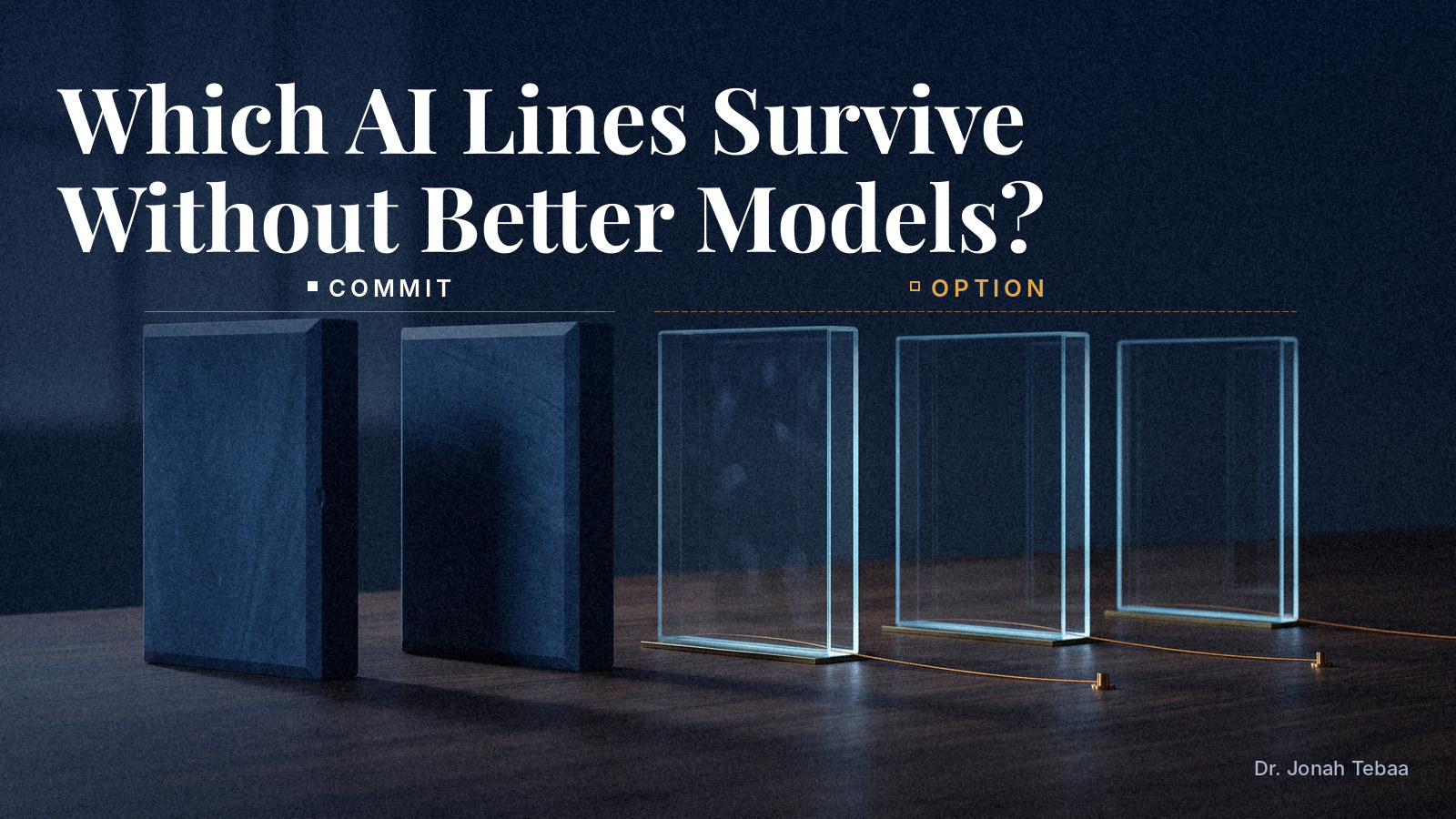
My claim is that a multi-year AI roadmap should sort every line into one of two kinds. A commitment works with today's models, so you fund it fully and give it a date. An option needs a capability that is not reliably there yet, so you fund it small, cap it, and attach a tripwire. A board cannot govern a plan whose lines carry different kinds of risk but look identical.
Two kinds of promise hide in one roadmap
Most roadmaps are ordered by priority, and the usual worry is that the company picked the wrong projects. That risk is real. A second risk is quieter: the list mixes two different kinds of promise under one format.
The first kind is a process bet. It pays off if the company does something within its own control: cleans its data, names a process owner, trains its staff. If it fails, the cause is inside the firm, and management can reschedule, reassign or escalate.
The second kind is a capability bet. It pays off only if the technology can do something reliably that it cannot do reliably today. If it fails, the cause is outside the firm, and no amount of management effort sets the date on which a model becomes good enough.
That difference matters most to a board. Capability gaps are the one dependency management can neither control nor schedule. Put a capability bet next to a process bet, give both a quarter and a budget, and the slide implies they are equally predictable. When a line then slips, the board cannot tell whether the team failed or the technology has not arrived yet.
The Commit-or-Option Sort in four steps
I call the method the Commit-or-Option Sort. Run it on every line, one at a time.
1. Name the dependency. Finish the sentence: "This line pays off only if ___." Allow one blank. If the honest answer takes a paragraph, the line is really two lines and should be split.
2. Classify. If the blank is about the firm (product data cleaned, a process owner named, staff trained), it is a process bet. If the blank is about the technology (the model must handle a certain task reliably), it is a capability bet.
3. Size. Process bets get a full budget and a delivery date. Capability bets get a capped option: a small pilot, one named owner and a fixed spend ceiling that cannot be quietly raised.
4. Set the tripwire. For each option, write one observable condition that converts it into a commitment, and one date or condition that closes it. The board sees tripwires, not progress percentages, because "70 percent complete" says nothing about whether the technology has crossed the line.
An option is not a polite way of saying "maybe later". It keeps the upside of a future capability while limiting what the firm pays to wait for it. A small, owned, capped pilot costs a fraction of a full commitment, and if the capability does arrive, the company is already close enough to use it.
This is a different job from the Stop List I described in Fourteen AI Requests, Budget for Three. The Stop List decides what to leave out when demand exceeds capacity. The Sort asks what kind of risk sits behind each line that stayed in, whether you have fourteen requests or five.
A worked example (composite)
This is a composite, not a real client. The distributor, the five lines and every percentage below are illustrative, built from the shape of plans I see in my work. Picture a regional distributor of building materials with around 200 staff, and a three-year AI budget that we will treat as 100 units.
| Line | Pays off only if | Type | Treatment | Budget |
|---|---|---|---|---|
| 1. Clean product and price data | The firm cleans the catalogue and names a data owner | Process | Commit, with a delivery date | 35% |
| 2. Quote drafting with human review | Line 1 is done and staff review every draft | Process | Commit, with a delivery date | 35% |
| 3. Automatic handling of messy supplier documents in mixed languages | The model reads them reliably | Capability | Option. Tripwire: agreed accuracy on a sample of 200 real documents | 12% |
| 4. Demand forecasting across seasons | The model forecasts seasonal swings better than the current method | Capability | Option. Tripwire: beats the planner's current method on last year's data | 10% |
| 5. Fully hands-off customer service | The model handles customers with no human check | Capability | Option, with a closing date | 8% |
Two commitments take 70% of the budget. Three options share the other 30%.
Look at what the sort exposed. Line 2 sits on top of line 1, because quote drafting only works if the price data is clean. That makes it a commitment with a company-side dependency, so the board should watch line 1 first. Nothing about line 2 requires a better model.
Line 3 was the line the original slide treated as most advanced. After the sort it is an option, with a tripwire the owner can test: the system reaches the agreed accuracy on a sample of 200 real documents. If it does, it converts to a commitment with a full budget. If it has not done so by its closing date, the money returns to the pool.
Line 5 is the clearest case. "Fully hands-off" is a statement about what the technology must be able to do unsupervised. A small, time-limited option is the honest way to hold that line in a plan.
The original slide asked the board to approve five lines. The sorted page asks it to approve two commitments and to watch three tripwires. The director's question now has an answer: lines 1 and 2 still work if the models never improve.
Questions a director can ask on the day
These five questions work on any roadmap, in the room, without notice.
- Which lines still pay off if the models stay as they are today?
- For each option, what is the tripwire, and who watches it?
- What is the spend ceiling on each option?
- When does each option close if the tripwire never fires?
- Which commitments are waiting on something the company itself must fix first?
The first question tells you how much of the plan is safe. The last one catches the commitment that is quietly waiting on someone else's cleanup. A team that can answer all five has usually done the Sort already. A team that cannot has just learned where its plan is thin, which is useful to learn before the budget is approved.
What changes in the board pack
The roadmap becomes one page with two columns. Commitments sit on the left, each with an owner and a delivery date. Options sit on the right, each with a ceiling, a tripwire and a closing date. The board reviews on fixed dates, and again whenever a tripwire fires. In between, nobody reports percent-complete on an option.
If your plan already follows the four-line shape I set out in The Board-Ready AI Roadmap Has Four Lines, the Sort slots in underneath it: it tells you which column each of those lines belongs in.
Take your own roadmap and write "This pays off only if ___" next to every line. How many turn out to be options?
Related evidence: RAND's study of AI project failures finds that misunderstandings and miscommunications about the intent and purpose of a project are the most common reasons AI projects fail. (RAND research on why AI projects fail)