
Her flight was thirty days away, the owner had a two-page handover template, and the real list of exceptions, once she began to talk, ran to thirty-one. He could have named two of them from memory.
The company in this piece is a composite I use to illustrate the method. It is built from patterns in my work, it is not a real client, and every number is illustrative, not research. A 60-person import and distribution company in Beirut. An operations coordinator, nine years in, tells the owner she is emigrating next month. His first plan is sensible and ordinary: a handover note and a new hire.
In Lebanon this is a routine operating event, not a crisis. Good people leave, they say so honestly, and they give a date. I will not comment here on why. What I care about is what the business does with the thirty days it has been given.
A Flight Date Is the Only Deadline You Get
Most losses of know-how are invisible because they arrive without a date. A person goes quiet, or is hired away, or simply stops answering. A departing employee with a booked flight is the opposite: you know the last working day, and you know it early. That is a gift, and it is usually spent on a farewell lunch and a document.
My claim is that a handover document saves the least valuable part of what the person knows. A document is good at procedures, and procedures are the part a competent successor could rebuild in a few weeks. It is poor at the things that took nine years to accumulate and that the leaver no longer notices she knows.
So I work backwards from the flight. I call the method the Flight-Date Capture. Write the last day at the top of a one-page plan. Week one is for choosing and sorting, weeks two and three are for capture, week four is for testing and fixing. And free the leaver's time on paper. In the composite, five hours a week came off her normal load, twenty hours in total. Without that, the capture is squeezed out by the daily work she is still doing and still responsible for, and it quietly never happens.
Four Kinds of Know-How a Handover Note Misses
The first job in week one is to sort what the person knows into four kinds. Each needs a different way of being captured, which is why a single document fails.
- WHO. Which counterparties trust this person, who answers the phone for her, and who must be introduced in person: customers, suppliers, the customs agent, the bank officer, the landlord.
- WHY-NOT. The exceptions to the written rule, and the reason each one exists. "We always give that customer 60 days." "Never ship to that area on Fridays."
- WHERE. Accounts, shared files, supplier portals, group chats, and who administers each. Also what lives on the leaver's personal phone and needs a consent-based transfer, not a copy.
- WHICH-WAY. The judgment calls. The honest question here is: what would have made you decide the other way?
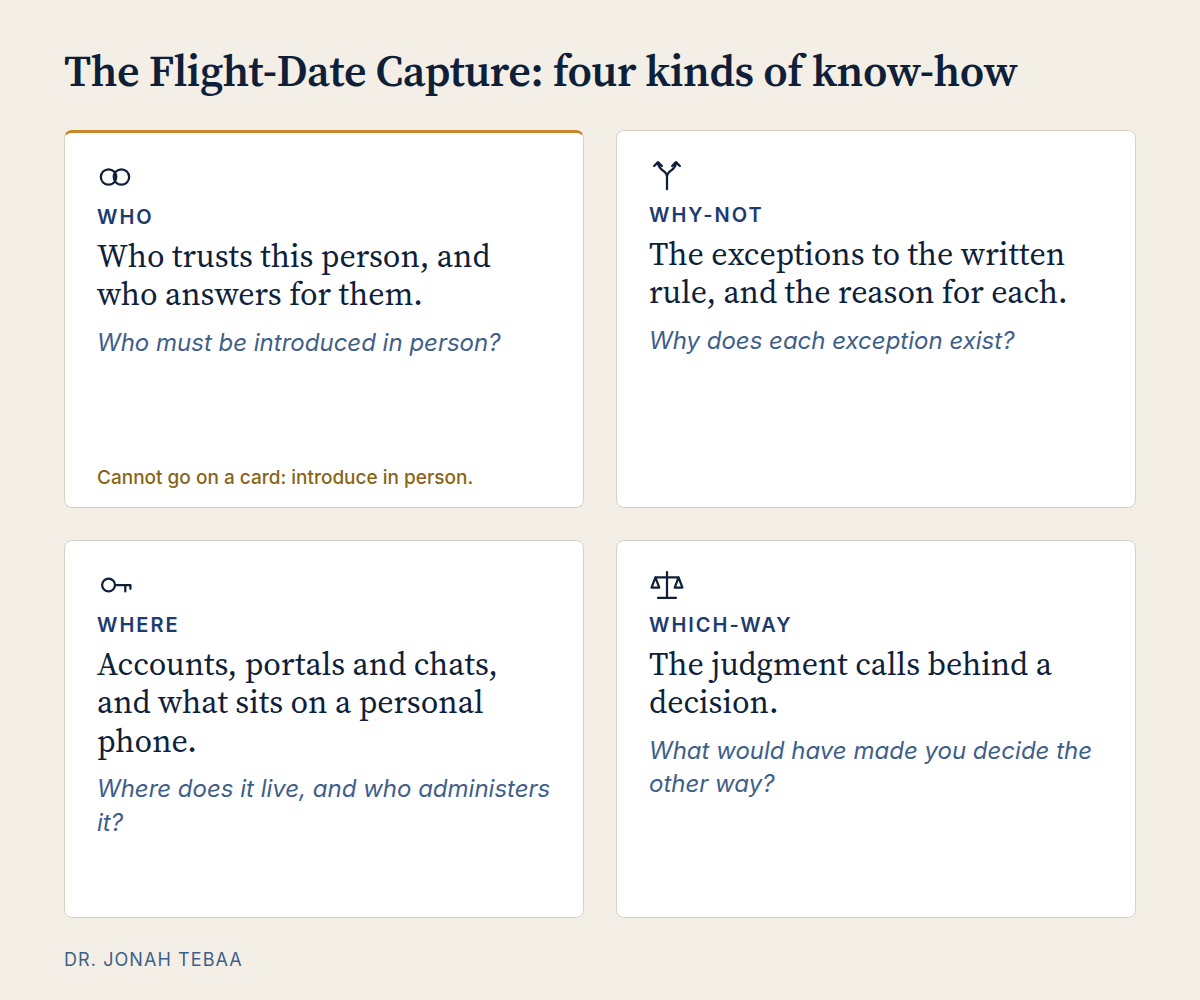
Notice that three of the four are things a person would never think to write in a manual. Nobody writes "the bank officer will only move fast if you call before ten." The rule has no heading, and the reason behind it is the valuable part.
Capture Real Cases, Then Let AI Do the Clerical Work
The method I trust is replaying real situations, not writing a manual. Pick eight to twelve recent real cases, the messier the better. The leaver talks through each one for 15 to 25 minutes, recorded with her consent, in whichever language she thinks in: Arabic, French or English. She is asked two questions per case. What did you decide? What would have changed your mind? The second question is where the WHY-NOT and WHICH-WAY material comes out.
This is the only place I use AI, and I keep it narrow. It transcribes the recording, translates if needed, and arranges each one into a one-page case card: the situation, the decision, the exception, who was involved, and where the files are. That is clerical work, and it is what the tools do well.
Then the leaver reads every card and corrects it. Nothing is filed until she has. I do not treat that as a formality; a card she has not corrected is a draft, not a record. Her corrections are also a useful signal of where the transcription and the real story diverged.
One more part cannot go on a card. In the last two weeks the leaver personally introduces the successor to the top five counterparties, by phone call or a joint message. Trust does not transfer through a PDF. It transfers when the person people trust says "this is who you deal with now."
A Composite: Eleven Recordings, Thirty-One Exceptions, One Test
Back to the composite company. Over weeks two and three, the coordinator recorded 11 real cases, about 4.5 hours of audio in total. AI produced a draft card for each. She corrected every one, changing on average two to three lines per card, mostly names and the reason behind an exception.
The four-kind sort produced this. In WHY-NOT, 31 exceptions, against the 2 the owner could have named himself. In WHO, 14 counterparties, of which she flagged 5 for an in-person introduction. In WHERE, two supplier portals registered on her personal email, and one customer group chat run from her own phone. None of these would have appeared in a two-page note. The portals, left untouched, would have become a locked door a month after she left.
Around day 21 the successor answered 8 realistic cases using only the cards, while the coordinator watched in silence. 4 of 8 were handled correctly. The 4 misses were three WHO gaps and one WHY-NOT gap. Fixes were made by day 28: two extra introductions and one new card. On the day-28 retest, 7 of 8 were correct. The owner accepted the one remaining miss as a named gap, in writing, with the coordinator agreeing to be reachable by message for 60 days.
The decision rule I state plainly to every owner is this: the leaver's last day is not done until the successor has passed the test, or the owner has accepted the named gaps in writing. The date on the calendar is not the finish line. The test is.
The Successor Test and What You Cannot Capture
I should be honest about the limits. Eight cases is a small sample. The successor test measures recall from the cards, not judgment under pressure with a customer shouting on the line. A pass is necessary, not sufficient. A card never replaces a relationship, and the first month after the last day will surface things nobody thought to ask.
Consent is the other limit, and it is real. Someone leaving under stress may not want to be recorded, and that is a reasonable position. Ask, explain what the recording is for and who will hear it, limit it to work cases, and be ready to accept a no or a pause. If the request sounds compulsory, the quality of what you capture drops with it. Business conversations on a personal phone should move by agreement, not by copying. Labour and data-privacy obligations differ, so check them with a local lawyer before you begin. This is an operating method, not legal advice.
If your concern runs the other way, and the person leaving is a builder of an AI pilot rather than an operations coordinator, I covered that separate case in The Handoff Nobody Documents.
If someone you depend on has just told you a date, the useful question is small: which of the four kinds would your business lose first? Write the last day at the top of a page today, and tell me what you found.
Related evidence: The truck factor is the minimal number of people who have to quit before a project is incapacitated; it measures how prepared a project is to deal with turnover. (the truck-factor research, which measures how many people can quit before a project is incapacitated)
Tacit knowledge is hard to write down, and effective transfer of it generally requires extensive personal contact, regular interaction and trust. (the research on tacit knowledge, which finds that passing it on generally requires extensive personal contact rather than a document)