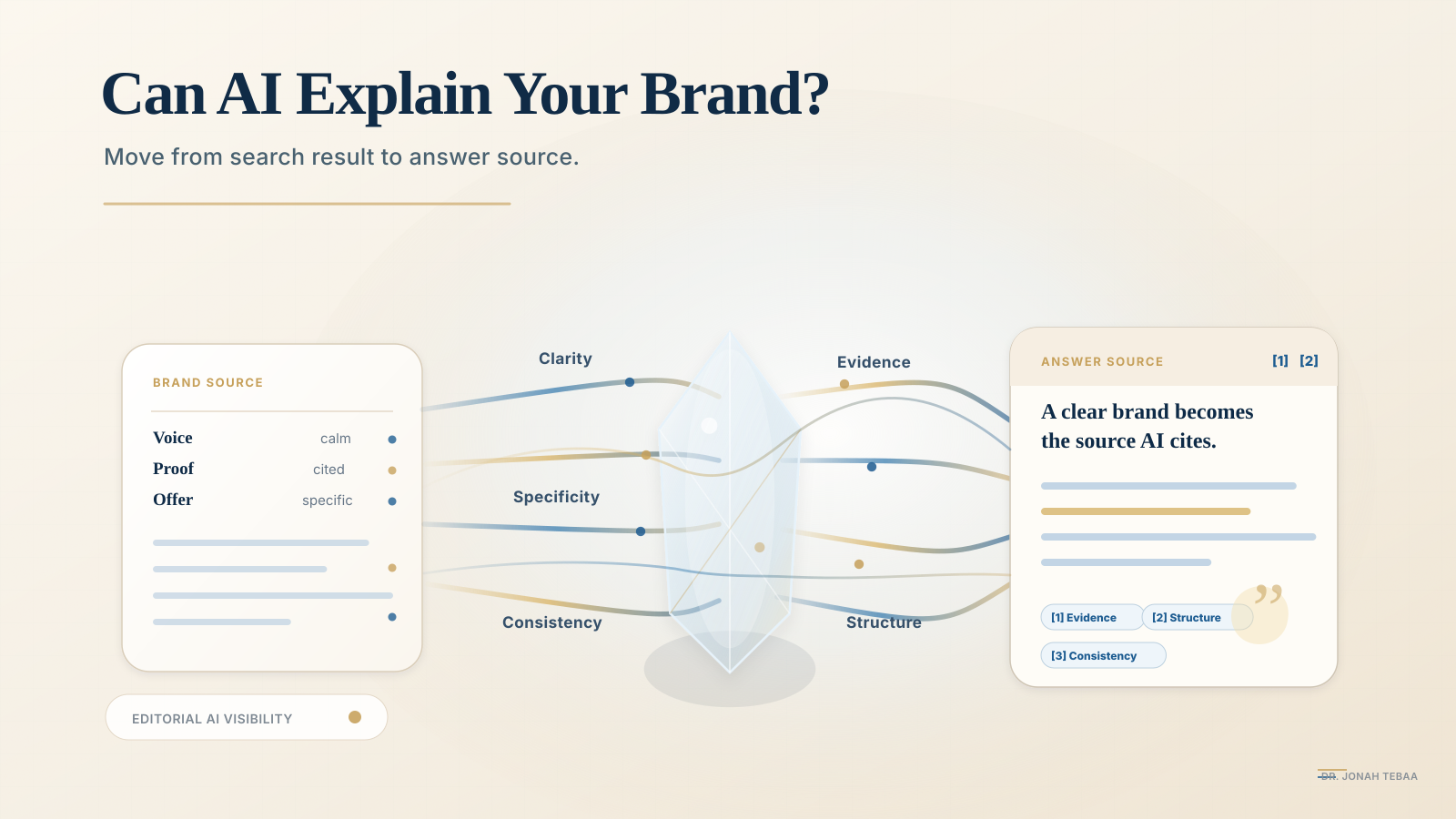
Search visibility is no longer only about ranking on a results page; it is about whether an AI system can understand, summarize, and confidently recommend your brand.
For years, the digital visibility conversation was dominated by SEO. Brands wanted to rank higher, win keywords, earn clicks, and capture attention inside search engines. That work still matters. But AI search has introduced a different kind of visibility problem.
The shift is measurable rather than merely asserted. Pew Research Center tracked the actual browsing behaviour of 900 US adults across 68,879 Google searches and found that when an AI summary appeared (Google's own name for the feature is AI Overviews), users clicked a traditional search result in 8% of visits — while those who saw no AI summary "clicked on a search result nearly twice as often (15% of visits)." Clicks on the links inside the AI summary itself happened in about 1% of visits. This is observed behaviour, not a survey of opinions, though it covers US users on Google in a single month. The practical consequence is blunt: on a growing share of queries the answer is consumed without a visit, so being mentioned inside the answer becomes the visibility that matters.
When someone asks an AI tool, “What is the best option for this?” or “Who helps with this problem?” the user may not see ten blue links. They may see a synthesized answer, a short list of options, or a recommendation based on what the system can understand from public information, structured pages, credible citations, reviews, comparisons, third-party mentions, and consistent brand signals.
SEO, AEO, and GEO are related, but not identical
SEO, or Search Engine Optimization, improves visibility in traditional search results. It focuses on discoverability, relevance, technical performance, links, and content quality.
AEO, or Answer Engine Optimization, helps answer-based systems extract clear, direct responses from your content. It rewards clarity, structured explanations, concise definitions, FAQs, and pages that answer real questions.
GEO, or Generative Engine Optimization, is about becoming a reliable source for generative AI systems. This includes not only your website, but your broader web presence: articles, profiles, citations, reviews, interviews, directories, social proof, and the consistency of your message across the internet.
The shift is simple but serious: brands are moving from trying to be clicked to trying to be understood.
Publishing more generic content will not solve this. In fact, generic content may make the problem worse. If your website sounds like every competitor, if your positioning is vague, if your proof is weak, and if your claims are scattered across different platforms, AI systems have very little reason to treat your brand as a confident answer.
What the engines themselves say — and what they say is a myth
This is a field with more folklore than evidence, so it is worth separating what the platforms have actually published from what the vendor market repeats. Google's own guide to optimizing for generative AI features on Search includes a section titled "Mythbusting generative AI search: what you don't need to do." Two of its findings cut directly against tactics sold as GEO essentials. On special AI-facing files such as llms.txt, Google is explicit that you do not need to create new machine-readable files or markup to appear in its generative AI capabilities — AI Overviews and AI Mode, the two surfaces the guide is written about — because "Google Search ignores them." On breaking pages into fragments, it states there is "no requirement to break your content into tiny pieces for AI to better understand it." What Google does endorse is the unglamorous half: content people find unique, compelling and useful, which it says will influence a site's presence in generative AI search more than any other suggestion in the guide.
That should be read narrowly and honestly: it is a statement about Google. Other engines are not Google, and several do fetch llms.txt, so the file is defensible as multi-engine coverage — it is simply not a way to rank in Google's AI features, and anyone selling it as one is contradicting the platform's published documentation.
On the academic side, the term itself has a primary source. The paper that named the field, "GEO: Generative Engine Optimization" (Aggarwal et al., KDD '24), introduced a benchmark of diverse user queries and reported that its methods "can boost visibility by up to 40% in generative engine responses," while noting that effectiveness "varies across domains." Two caveats belong with that number every time it is quoted: the primary engine tested was GPT-3.5-era, and the paper's own limitations section expects the methods to need adaptation as generative engines evolve. Treat it as directionally useful, not as a current, calibrated forecast — and be sceptical of the far larger percentages circulating in vendor marketing, which typically describe a different experiment than the one being implied.
The brands that win will be answerable brands
An answerable brand is easy to understand, easy to verify, and easy to recommend in context. It gives both humans and machines a clear picture of what it does, who it serves, why it is credible, and where it fits in the market.
A practical framework has five parts.
1. Clarity
Can your brand be explained in one accurate sentence?
Many businesses describe themselves with broad language: innovative, full-service, cutting-edge, results-driven. These words are not wrong, but they are not very useful. They do not help an answer engine understand the specific problem you solve.
A clearer version states the category, audience, problem, and outcome. For example: “We help independent clinics reduce missed appointments through automated patient communication.” That is easier to understand, compare, and recommend than “We provide innovative healthcare solutions.”
2. Specificity
AI systems respond better to concrete information than vague positioning.
Your site should make it obvious what services you offer, who they are for, what industries you understand, what use cases you support, and what outcomes you are associated with. A strong brand page answers the questions a serious buyer would ask before booking a call.
- What do you do?
- Who do you serve?
- What problems do you solve?
- What makes your approach different?
- What evidence supports your claims?
- When are you not the right fit?
3. Consistency
AI search does not only look at your homepage. It can draw from your website, business profiles, articles, social platforms, review sites, public listings, podcasts, videos, and third-party mentions.
If each source describes your brand differently, the system receives a mixed signal. Consistency does not mean repeating the same sentence everywhere. It means your core category, audience, claims, names, locations, services, and proof points should align across the web.
4. Evidence
AI systems are designed to avoid unsupported confidence. If your brand makes claims without proof, those claims are weaker as answer-source material.
Evidence can include case studies, testimonials, measurable outcomes, credentials, media mentions, awards, published research, comparison pages, documentation, and strong reviews. The goal is not to exaggerate authority. The goal is to make trust easier to verify.
5. Structure
AEO and GEO reward content that can be parsed. Your pages should be organized with clear headings, direct answers, logical sections, schema where appropriate, FAQ blocks, service pages, author information, internal links, and concise summaries.
A beautiful page that hides the answer is less useful than a structured page that explains the answer clearly.
A practical AI-search audit
This week, open three AI tools and ask:
- What does this brand do?
- Who does this brand serve?
- Why should someone trust this brand?
- What alternatives might someone compare it with?
- What questions would a buyer still have before choosing it?
Then review the answers carefully. Are they accurate, specific, and current? Are they missing your strongest proof? Are they confusing you with another brand? Are they describing your category correctly?
If the answers are weak, the issue is not only the AI tool. It may be a signal problem. Your brand may not be clear enough, structured enough, cited enough, or consistent enough across the web.
What to do next
Start with the pages that matter most: homepage, about page, service pages, case studies, FAQs, and public profiles. Rewrite vague language into clear positioning. Add proof where claims appear. Make your service categories explicit. Publish answers to real buyer questions. Update inconsistent profiles. Build credible mentions beyond your own website.
AI search visibility is not about gaming a new algorithm. It is about becoming a better source.
The future belongs to brands that can be understood quickly, trusted responsibly, and recommended accurately.
Run one AI-search audit this week: ask three AI tools to explain what your brand does, who it serves, and why it should be trusted. The gaps will show you where your GEO and AEO work should begin.