
A building-materials supplier in Mount Lebanon sends out 120 quotes in a month. Within 48 hours, 71 of them have gone quiet. The AI that answers the company's WhatsApp enquiries has been set to write to every quiet lead at 24 hours, at 72 hours and at 7 days. That is three messages to each of 71 people, 213 messages in all. Nine people reply. Six of the nine say, in one phrasing or another, stop messaging me. Two opt out. One reply turns into an order.
This is a composite. I built it from patterns I see in this kind of work, and it is not one client or a measured result. I use it because the shape is familiar: a setting that sounds like diligence, and a month of numbers that say otherwise.
I have already written about what a sales AI may promise while the customer is still talking, in the commitment ladder. This piece is about the moment after, when the customer has stopped talking and the AI has to decide whether to speak first. Silence is where the most obvious setting, persistence, does the most damage.
Why silence is information, not a gap to fill
In a WhatsApp-first market, a quiet lead is rarely a lost lead, and rarely an ignored one. The message was often read. The blue ticks are there. The customer simply has not answered, and the reasons are ordinary:
- The quote is being shown to a brother, a partner or a father who decides.
- A competitor's price is arriving, and the customer is waiting to compare.
- It is a holiday week, or a week of power cuts and patchy connectivity, and nobody is thinking about tiles.
- The money is not due until the end of the month, and the customer knows it.
Each of these calls for something different. None of them calls for "just checking in."
The cost of getting this wrong is mostly invisible. The customer who writes "stop messaging me" is the visible one. Most people who feel the same way mute the chat and say nothing, and you never learn about it. On WhatsApp that matters twice, because a muted or blocked business number is also a number that no longer reaches them with the delivery update, the invoice or the stock they did want. Every unwanted nudge spends goodwill you cannot see on a balance sheet.
The four conditions that grant permission
The rule I give owners is short. The AI may follow up on a quiet lead only when all four conditions hold. If any one fails, it stays silent, and the lead goes either to a person or to the "leave alone" pile.
- A reason. The message must connect to something the customer said or asked: a date they mentioned, a decision they said was pending, a question left open. A follow-up with no thread back to the customer's own words is a broadcast.
- A new fact. There must be something the customer did not have when they went quiet. A price that is about to expire, stock that has arrived, a corrected specification. Never "just checking in," and never "did you see my message."
- A spacing limit. One message, then wait. At most two per enquiry, ever. Nothing outside reasonable local hours, and nothing on days the customer's own pattern suggests are closed to business, such as Fridays, Sundays or a holiday they have observed.
- A clean exit. A single line that lets the customer say "not now" or "stop," and a system that honours it permanently, across every future campaign, not only this thread.
Notice what is missing. Persistence is not a condition. There is no dial marked "try harder," and I would not install one.
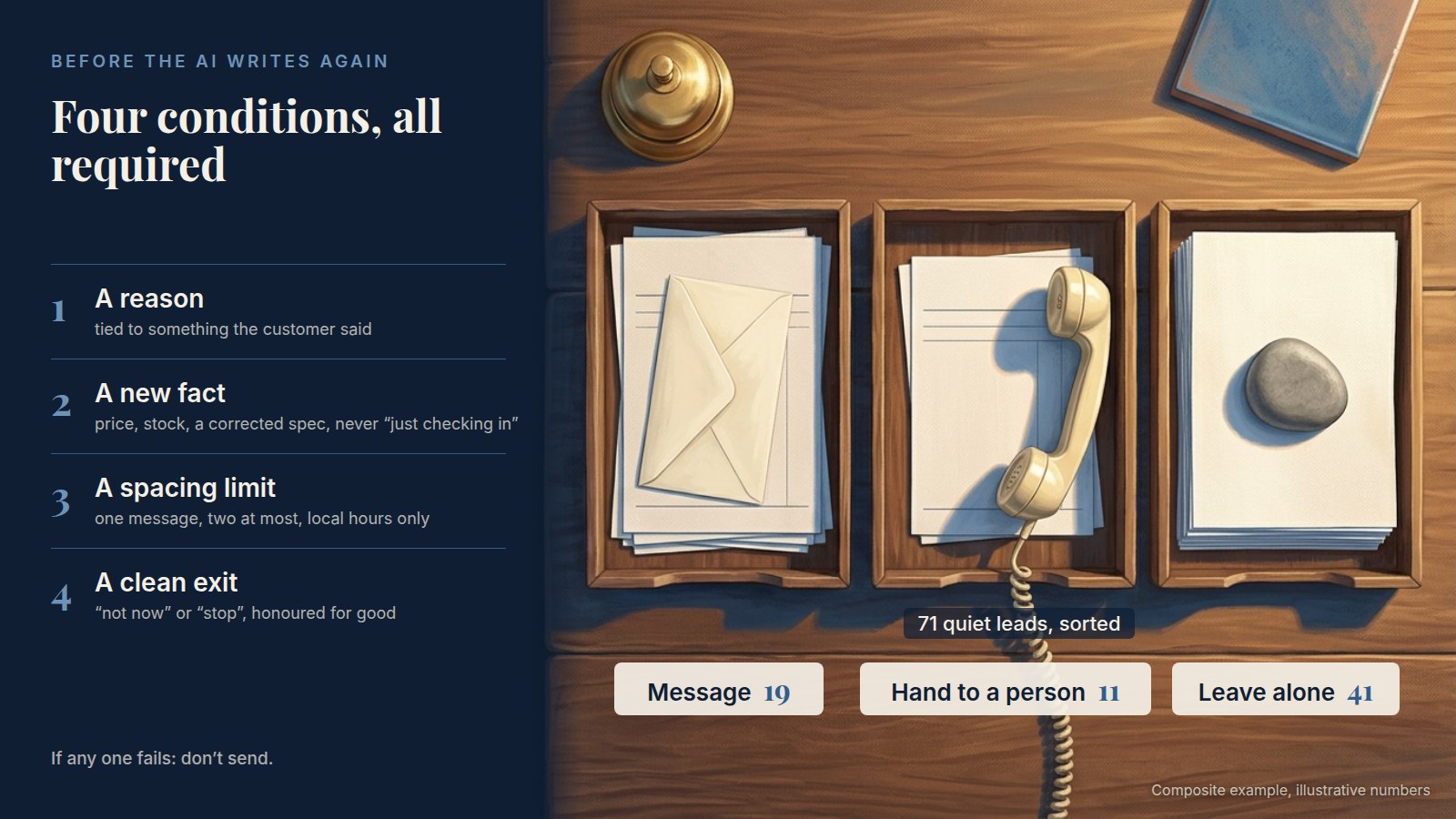
A worked example: 71 quiet leads, sorted three ways
Return to the supplier. Under the old setting, 213 messages produced 9 replies. Six said stop, two opted out, and one turned into an order. That is the entire return on a week of automated persistence per lead, and it is the reason the owner called me.
We changed one thing. Instead of a timer, the 71 quiet leads were sorted, each against the four conditions, into three piles.
- Message: 19 leads. Each had a reason and a new fact. A customer had asked about a delivery date and the stock had now arrived. A quote carried a price that would expire on a stated day. Each got one message, with an exit line, and nothing more.
- Hand to a person: 11 leads. These were warm and large, or the customer had said something that deserved a human voice. A salesperson received a call task with the context written out. The AI sent nothing.
- Leave alone: 41 leads. No reason, no new fact, or the customer had asked for time. The AI stayed silent, and nothing was sent that could cost goodwill.
The arithmetic checks: 19 plus 11 plus 41 is 71. The result in the composite was 12 replies and 5 orders from the same 71 quiet leads, against 9 replies and 1 order before. Fewer messages, more orders, and nobody asked us to stop. I would not promise those figures to anyone. I would promise that when every message has a reason and a fact, each one is worth reading.
Who decides when the AI should not write
The sort above needs an owner, and the owner is a person. Two cases should be decided in advance, in writing, rather than left to the AI's judgement in the moment.
First, the lead that is warm and high-value. If a quote is above a figure the owner chooses, or the customer has been engaged for days, a person calls. A message from an AI to someone who is about to spend serious money on building supplies can feel like being processed. A call feels like being served.
Second, the lead that has asked for time. "After Eid," "when the shipment clears," "next month." That customer has told you exactly when to speak again. The AI records the date and stays silent until it arrives. If the AI writes in the meantime, it is telling the customer that it did not listen.
I would add one thing about proactive messages in general. They work best when they spare the customer a question, which I covered in the piece on messages nobody had to send. A follow-up that does the opposite, by creating a task of replying, is the weakest kind.
What to measure
Do not judge follow-up by reply count. A reply that says "stop" is a reply. Count, for every 100 messages sent:
- Positive replies.
- Stop replies and opt-outs.
- Orders per message sent.
In the composite, the old setting produced 9 replies from 213 messages, about 4 per 100. Eight of those nine were stop replies or opt-outs, about 3.8 per 100, and one was an order. The owner had been reading "nine replies" as engagement. Read per 100 messages, it looked very different.
The stop-reply rate is the guardrail. If stop replies and opt-outs together climb past a few per 100 messages, tighten the rules before you do anything else, whatever the order count says. A few percent is a judgement, not a law, so set your own line before you look at the results, and write it down.
The principle, and a request
Follow-up is a permission the business grants in writing, and a quiet lead is a person with a reason. Write the four conditions for your own business: what counts as a reason, what counts as a new fact, how many messages is the limit, and what the exit line says. Then send them to me through the contact page. I would like to see what other owners decide.
Composite note: the supplier, the 120 quotes and the figures above are an illustrative composite built from patterns in my work. They are not a single client and not a measured result.