A board with $900,000 to allocate across three AI proposals in a single cycle will, left to its own instincts, fund the biggest ROI number on the page. I want to walk through a cycle like that — an illustrative composite drawn from patterns I see across engagements, not a single named client, but close enough to real that the arithmetic should make you uncomfortable.
Three Proposals, One Budget, One Vote
Three proposals competed for one $900,000 capital allocation. Proposal A was predictive maintenance — a sensor and model layer bolted onto production lines, asking $340,000, projected at 11% ROI over three years, the least exciting number in the room. Proposal B was an AI customer-service layer replacing 18 contact-centre roles, asking $280,000, projected at 24%. Proposal C was a dynamic-pricing engine embedded into roughly 600 active customer contracts, asking $280,000, projected at 32% — the best number in the deck.
Ranked by ROI, the vote is not close. The board funds C first, B second, and defers A to the next cycle for lack of remaining budget. That is the standard allocation logic in most capital committees I sit across from. It is also precisely backwards.
The Question ROI Doesn't Answer
ROI answers one question: what does this initiative return if it works. It says nothing about what it costs to discover that it doesn't. Every one of these three proposals carries a real chance of failing to perform as modeled — Gartner has put the share of generative-AI initiatives abandoned after proof-of-concept at roughly three in ten, and abandonment is never free. It carries severance costs, contract costs, legal costs, brand-repair costs, and the opportunity cost of the capital tied up while the organization figures out it bet wrong.
Boards that only underwrite the upside are underwriting half a decision. The NIST AI Risk Management Framework exists precisely because the downside of an AI initiative is not symmetric with a normal capital project — the failure mode isn't just "the return doesn't materialize," it's "the system is now embedded in operations, contracts, and customer relationships in ways that make reversal its own multi-month project." A capital committee that prices upside on a three-year model and prices downside not at all is not being rigorous. It is being incomplete in a way that flatters the proposal with the boldest projection. Reversal cost is the metric boards skip when they fund AI projects, and skipping it is exactly what lets the boldest projection read as the safest one.
The Reversal-Cost Ratio
The sharper question a board can put to any AI proposal is not "what does this return," but "what does it cost us to find out we were wrong, and how fast do we find out." I call the resulting number the reversal-cost ratio, and it is built from four inputs a committee can request from every sponsor before a vote:
- The capital ask — the number already on the slide.
- The full unwind cost — decommissioning the systems, unwinding the people decisions (severance, rehiring, retraining), renegotiating or exiting the contracts, and covering the legal and brand exposure of reversal.
- Time-to-first-reliable-signal — how many weeks or months before the organization has real evidence the initiative is working or isn't, not the vendor's projected ramp.
- The ratio itself: unwind cost divided by capital ask. Under roughly 30% and a wrong bet is cheap and fast to correct. Approaching or exceeding 100% and unwinding costs as much as or more than building — the initiative is not just an investment, it is a one-way door dressed up as a reversible one.
This is not a hypothetical governance nicety. The EU AI Act's risk management provisions describe risk management as a continuous, iterative process across the system's lifecycle, not a one-time approval gate — which is another way of saying the moment of funding is not the moment the risk gets assessed once and filed away. The reversal-cost ratio is what makes that continuous assessment concrete enough for a capital committee to act on in a single meeting, with numbers rather than sentiment.
Re-Ranking the Same Three Proposals
Run the same $900,000 and the same three proposals through the ratio instead of the ROI column, and the picture flips.
Proposal A's unwind cost — decommissioning the sensor pipeline and reverting to the manual maintenance schedule — comes to roughly $45,000 against a $340,000 ask: a 13% ratio. Wrong is cheap here, and the organization finds out fast. Proposal B's unwind cost — severance, rehiring, retraining, and service-quality remediation for 18 replaced roles — runs to roughly $310,000 against a $280,000 ask: 111%. Proposal C's unwind cost — renegotiating pricing terms across roughly 600 live contracts, the legal review that requires, and the customer-trust remediation on top — runs to roughly $460,000 against a $280,000 ask: 164%, the worst ratio on the page, attached to the proposal with the best ROI on the page.
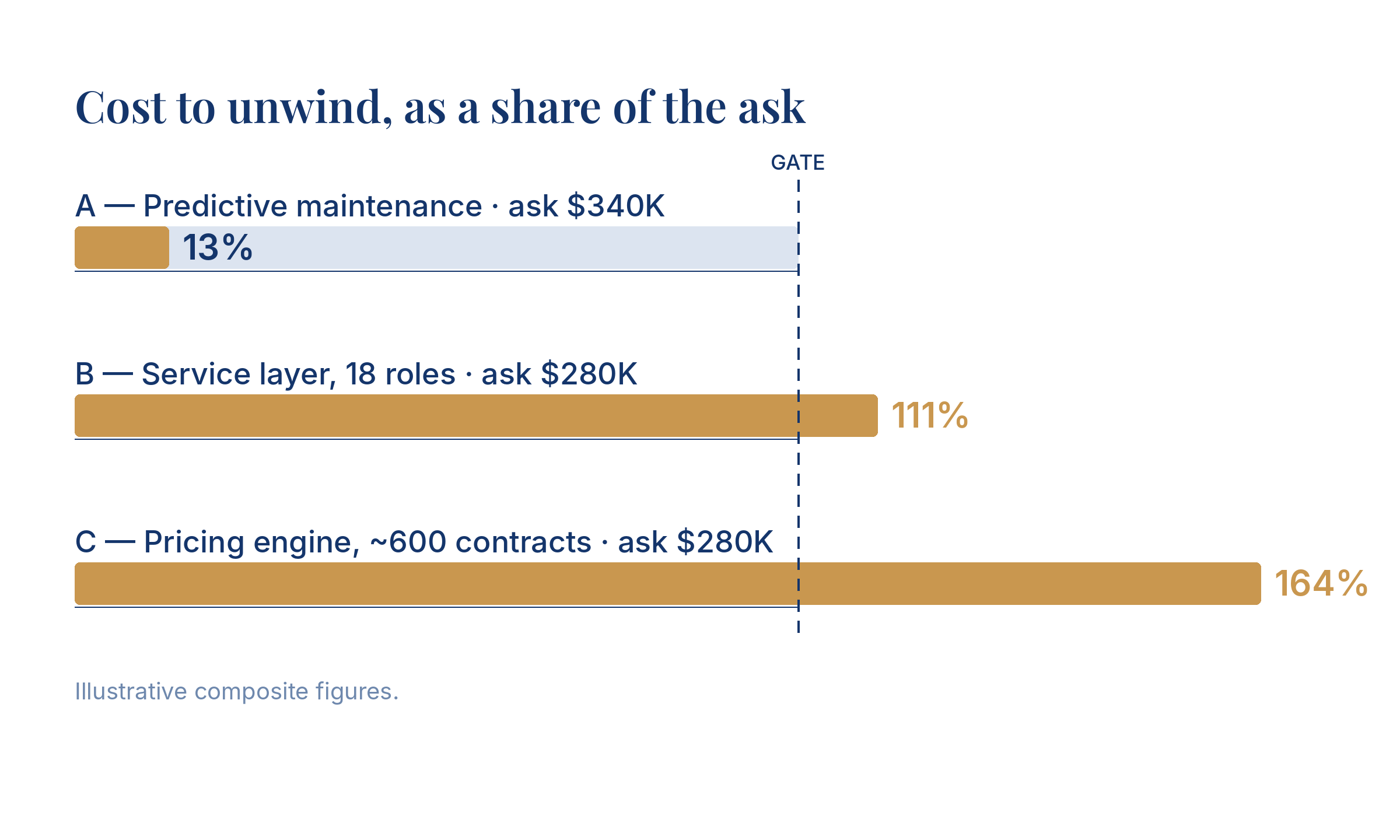
That inversion is not a coincidence. The initiatives with the most attractive projected returns are frequently the ones woven most deeply into people, contracts, and customer relationships — which is exactly what makes them expensive and slow to unwind if the projection is wrong.
What Changes on the Roadmap
Re-ranked this way, Proposal A gets funded outright and immediately — cheap to be wrong, fast to learn, no reason to gate it. Proposals B and C do not get deferred and they do not get killed. They get funded behind staged gates: a bounded pilot cohort instead of full deployment, a hard evidence checkpoint before the next tranche of capital releases, and a pre-agreed unwind trigger written down before the money moves, not negotiated after the numbers come in soft. Same $900,000, same three proposals, an entirely different commitment schedule — and a materially different story to tell the audit and risk committee if one of them goes wrong.
This matters more, not less, as AI capital allocations grow. Stanford HAI's 2026 AI Index reports that "Organizational adoption reached 88%", so adoption itself is no longer the constraint. What I see in my own work is a wide gap between the organizations that have adopted AI and the much smaller share capturing real enterprise-level value from it — and that gap is rarely a model-quality problem. It is a governance problem: boards funding the initiatives that look best on a three-year projection instead of the ones that are cheapest to correct if the projection is wrong. Rank by ROI and you fund your best story. Rank by reversal-cost ratio and you fund your best-protected bet — and the two lists are not the same list.