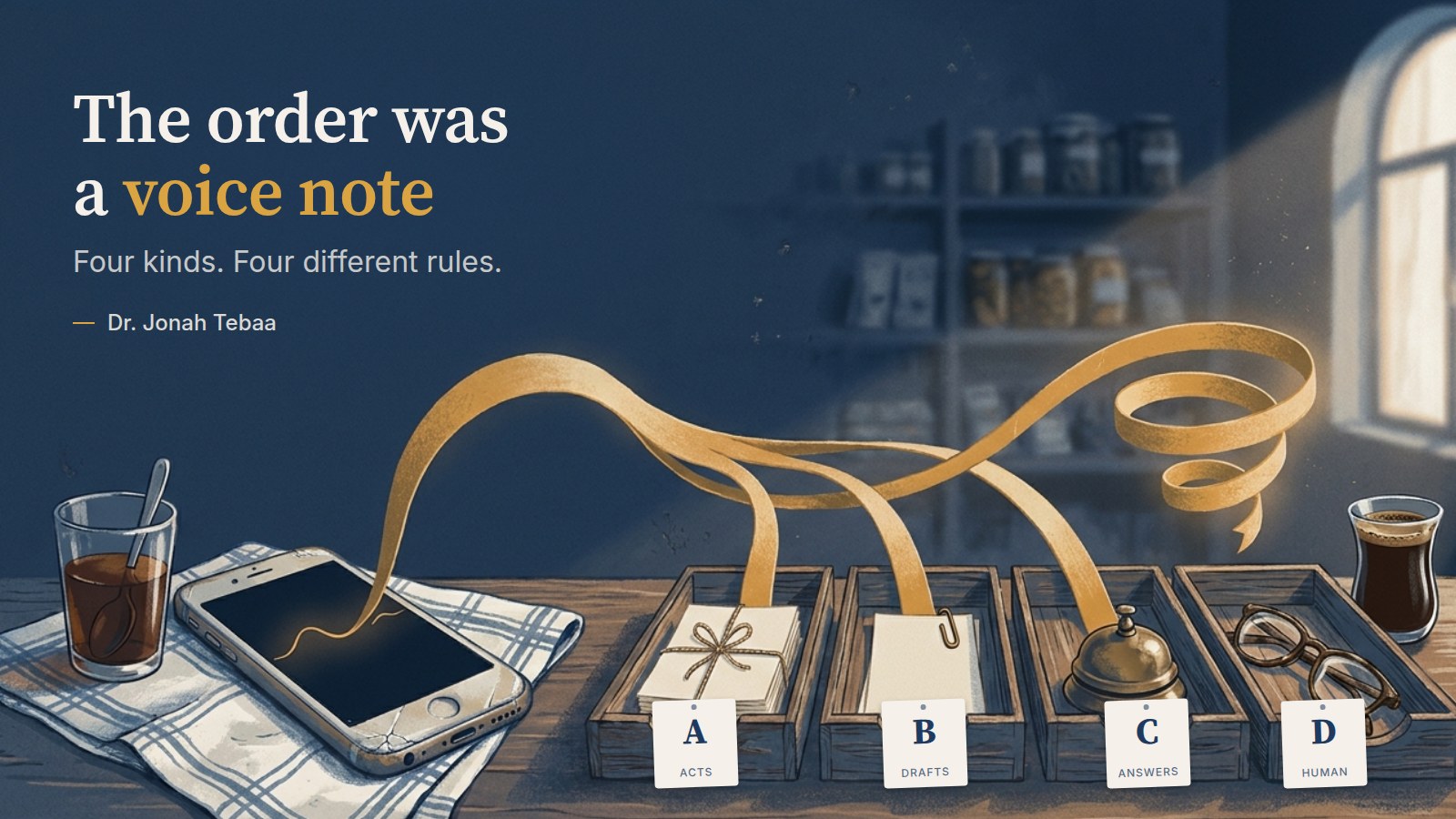
It is 7:40 on a weekday morning, and a food supplier in the Beirut area opens WhatsApp to 23 unread messages. Fourteen of them are voice notes, between 8 and 40 seconds long. One reads, in sound, like this: "the usual, but double the labneh, and not Thursday," spoken over the hum of a generator. This is a composite I use when I describe the problem to owners. The supplier, the numbers and the sentence are assembled from patterns, not from one client.
The owner has a vendor demo at 11. The vendor will show an assistant answering typed questions, politely and fast. Nobody in that room will play a voice note.
That gap is what this piece is about. Not whether to test an AI on your real traffic. I have written about that, and the companion piece on the Arabic customers type covers the typed side. This one is about what to do once you accept that a large share of your orders are spoken. A voice note is not one kind of message, and an AI should not be given one kind of permission for all of them.
The order form nobody designed
In my work with Lebanese and wider MENA businesses, the voice note turns up as the real order form. Nobody planned it that way. People speak because speaking is faster than typing Arabic on a phone keyboard, and because it is warmer. A voice note says "I know you, you know me." A typed order reads like a form.
A spoken order also carries things a typed one rarely does:
- Shared history. "The usual" only means something to someone who remembers the usual.
- Conditions tucked into the middle. "Not Thursday" arrives as an aside, after the order, in the same breath.
- Mixed languages inside one sentence. Arabic, French and English, switching mid-clause, often on the nouns that matter most.
- Noise. A generator, a street, a car, a child. The audio is rarely clean.
Vendor demos use typed text because typed text is predictable and easy to show. That is not dishonest. It is just not your business. A customer who sends a 23-second note has done their part of the work. If your system hears only the words and misses the condition, the order is wrong, and the customer knows the wrongness came from you.
Four kinds of voice note
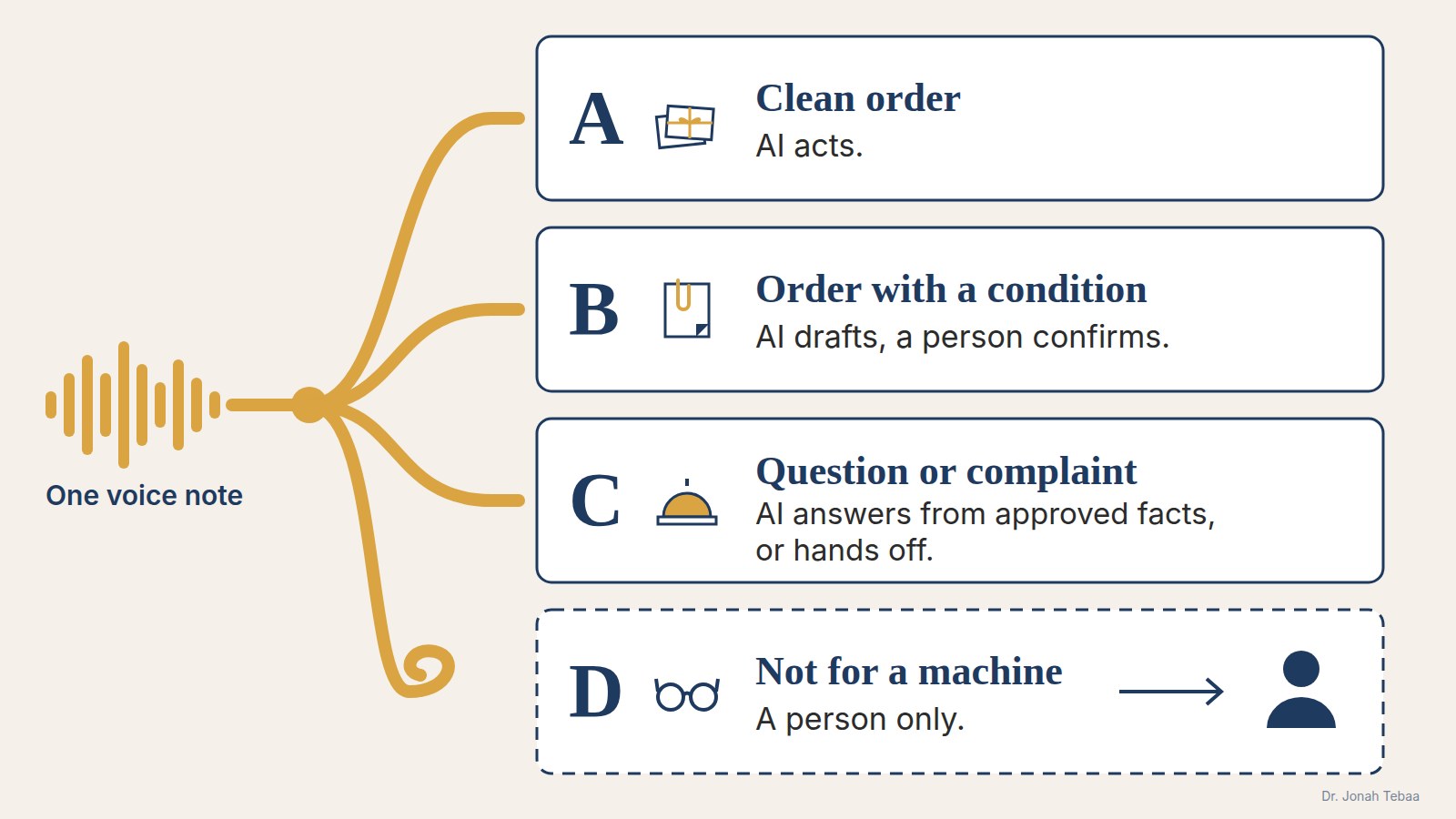
The mistake I see most often is treating "voice notes" as one category and asking whether the AI can handle it. The better question is which kinds exist in your inbox, and what the AI is permitted to do with each. I sort them into four.
- Kind A: the clean order. A product, a quantity, a delivery detail, nothing unusual. "Ten cartons of the white cheese, tomorrow morning." The AI may act: record the order and confirm it back.
- Kind B: the order with a condition or exception. "The usual, double the labneh, not Thursday." The order is real, but it is bent by a condition. The AI drafts, a person confirms: it prepares the order and flags the condition it heard, and a staff member approves before anything is committed.
- Kind C: a question or complaint. "Where is my delivery?" or "The yoghurt was warm." The AI answers only within approved facts, or hands off: it may state an opening time or a delivery window you have written down, and otherwise passes the note to a person with a short written summary.
- Kind D: not for a machine. A personal message, an upset customer, a dispute about money, a negotiation. Human only: the AI does not reply. It routes the note, untouched, to someone with the standing to respond.
Notice what this does. It stops the argument about whether the AI is "good enough" and replaces it with a narrower, answerable question: good enough for which kind? An assistant that is excellent at Kind A and unreliable at Kind B is still useful. It is only dangerous if it is allowed to treat B as A.
The one-afternoon sorting exercise
You do not know your mix until you sort it. The share of A, B, C and D differs sharply between a bakery, a clinic and a spare-parts distributor, and I would not guess yours. Here is the exercise I give owners. It takes an afternoon and one patient staff member.
- Pull about 40 recent voice notes. Use ones where the sender has agreed, or have staff re-record real patterns in their own words. Include the noisy ones. Keep them off public websites and delete the copies when you finish.
- Have a person write down what each one means. One line each, including any condition. "Usual order, labneh doubled, no delivery Thursday." This written line is your answer key.
- Mark each note A, B, C or D. Count them. This count is the most valuable output of the afternoon, and it costs nothing.
- Set your pass line before you look at any results. For example: no missed condition on any B, and every D handed off untouched. Write it down. A pass line chosen after you have seen the scores will drift toward whatever the scores were.
- Run the AI on the same notes. Do not clean or trim the audio first.
- Score by kind. On A, did it get the order exactly right? On B, did it catch the condition? On C, did it answer only from approved facts or hand off? On D, did it stay silent and route?
Forty notes will not give you statistics, and they are not meant to. They show you the pattern: where the system is solid, where it is guessing, and which kind it confuses with which.
What the result should change
Back to the composite. Suppose the supplier's forty notes sorted into 21 of Kind A, 11 of Kind B, 6 of Kind C and 2 of Kind D. These figures belong to the composite and are not a benchmark for anyone. The AI handled the A notes cleanly. On B, it captured "the usual" and "double the labneh" and missed "not Thursday" in several notes. On D, it replied to a customer who was angry about a disputed invoice, which was the one outcome the owner had ruled out in advance.
The decision that follows is not "buy" or "reject." It is a set of permissions:
- Kind A: the AI acts and confirms.
- Kind B: the AI drafts, and a person confirms every one for the first 30 days, then the owner reviews the misses and decides whether the rule can loosen.
- Kind C: the AI answers from a short list of approved facts, and hands off the rest.
- Kind D: no reply from the AI, ever, until the failure on that disputed invoice is fixed and retested.
The same result gives you three questions to put to the vendor in writing, which is a very different conversation from the one the demo invited:
- Does the system accept audio directly, or does it convert the note to text first, and what is lost in that step?
- What does it do with background noise and with mid-sentence language switching?
- What does it return when it is unsure: a guess, or a flag a person can see?
If a vendor cannot answer the third question plainly, you have learned something the demo would never have shown you.
What I would do on Monday
Ask whoever handles your WhatsApp to save forty recent voice notes by the end of the day, and to write one line on what each one means. Sort them into A, B, C and D before anyone mentions a vendor. If you would like a second pair of eyes on the sort, write to me through the contact page and I will happily look at how your mix falls.
Back in the composite, the supplier plays the 23-second note a second time over his coffee, hears "not Thursday," and writes it on the delivery slip himself. The question for the 11 o'clock meeting has changed. It is no longer whether the assistant is clever. It is which of these notes it is allowed to touch.
Composite note: the supplier, the morning and the forty-note result above are an illustrative composite built from patterns in my work. They are not a single client and not a measured result.