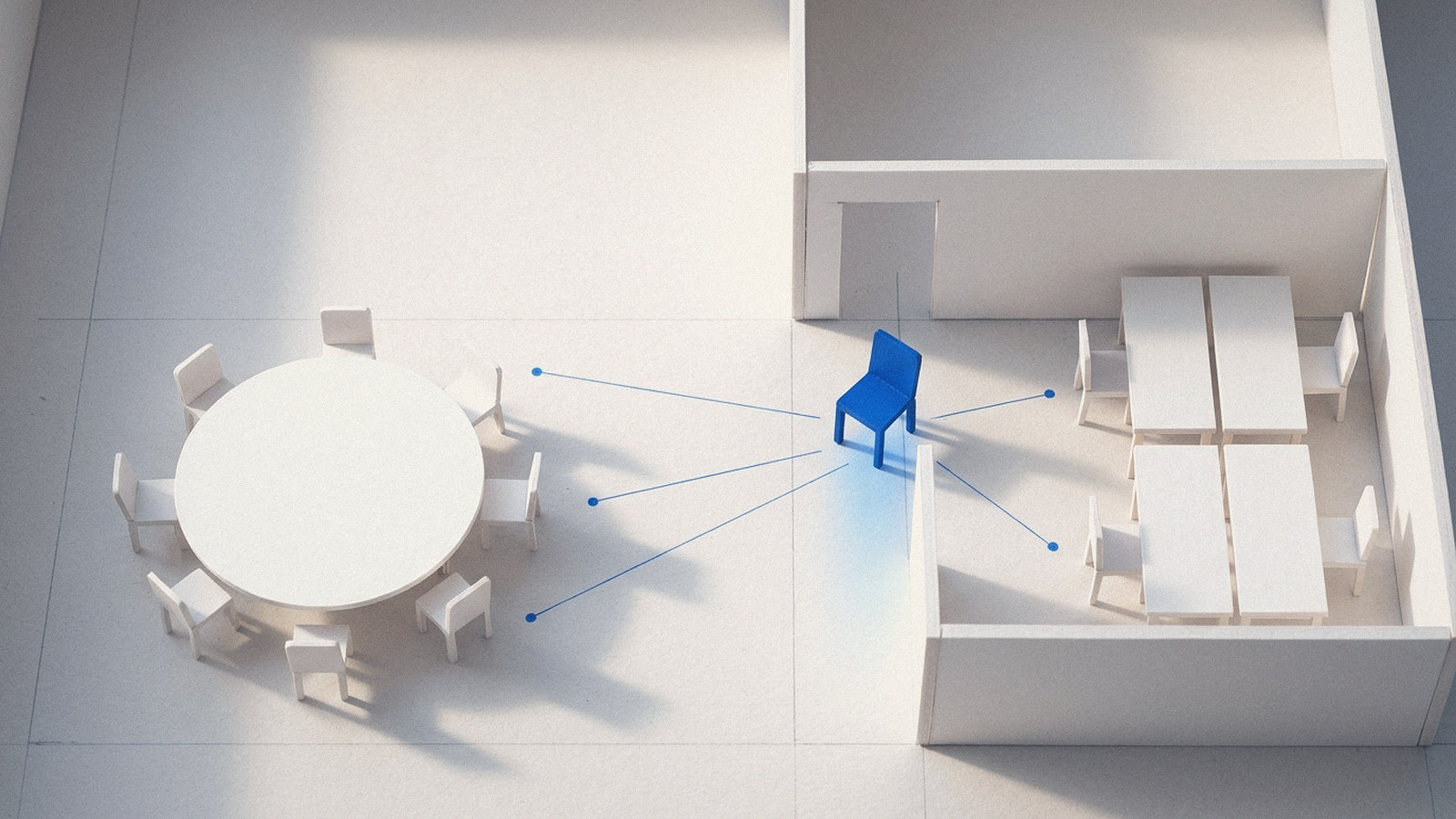
A distributor changed one pricing rule on a Monday morning. Sales knew by ten o'clock. The quote-drafting e-mployee, which is my term for an AI worker given a defined role inside a team, kept applying the old rule anyway. Every change to it had to go through a request to the central AI group, and the request sat in a queue until the following Tuesday.
Eight days of quotes went out on the wrong rule. Nobody was careless. The salesperson who spotted the error reported it at once, and the central team worked its queue in order. The worker sat in the wrong place.
Where an e-mployee sits on the org chart is a design decision, yet most companies make it by default. The seat usually goes to whichever group built the worker. I think the seat should follow the work instead, and I use five questions to find it. I call the method the Seat Sort.
Why the default answer fails both ways
Two defaults compete. The first is to centralise every e-mployee. You get one standard, one audit trail and one place to hire scarce skills. You also get slowness, and distance from the people who first notice that something is wrong. A salesperson sees a bad quote within minutes. A central team sees it after a ticket has travelled.
The second default is to embed every e-mployee in the team that wants it. Each team moves quickly. Then five teams build five copies of one invoice-matching worker, each with slightly different rules, and nobody can say which version is correct when finance asks.
Both defaults decide the seat before anyone has looked at the work. They also hide their cost. A misplaced worker rarely fails loudly. It produces a steady trickle of corrections, workarounds and late fixes that nobody adds up. The Seat Sort starts with the work.
The Seat Sort: five questions
Take one e-mployee and answer five questions about it. Each answer points to Team, to Centre or, less often, to Split.
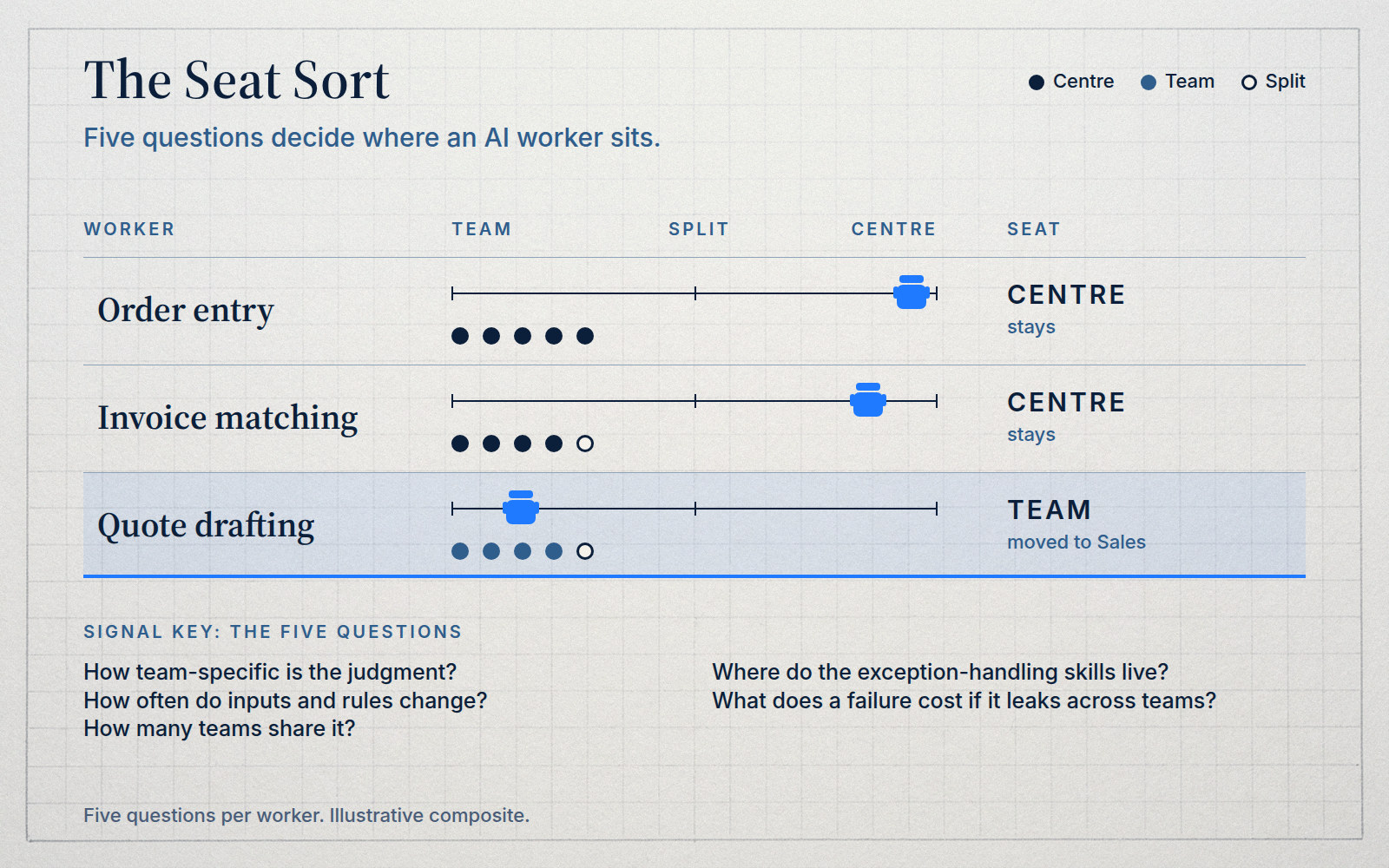
- How team-specific is the judgment? If the rules are understood mainly by one team, the answer points to Team. If they apply the same way across the business, it points to Centre.
- How often do inputs and rules change? Frequent change points to Team, because the people closest to the change can act on it the same day. A rule reviewed once a quarter points to Centre.
- How many teams share it? One team points to Team. Several teams point to Centre, because copies drift apart.
- Where do the exception-handling skills live? If the people who resolve odd cases sit in the business team, the answer is Team. If they sit in a shared desk or a technical group, it is Centre.
- What does a failure cost if it leaks across teams? If a wrong output stays inside one team, the answer is Team. If it flows on to finance or to another team's customers, it is Centre.
Now tally. Mostly Team answers mean embed the worker in the team. Mostly Centre answers mean centralise it. A mix means Split, and the clearest sign is when questions 2 and 5 pull in opposite directions: the rules change often, which says Team, while a failure spreads widely, which says Centre. That tension is exactly what a split exists to resolve.
What a split actually means
A split divides the job instead of averaging two seats. The centre builds, tests, versions and keeps the change log. The team runs the worker day to day, handles its exceptions and proposes changes.
What holds it together is a written handoff. It says who may change what and how fast the centre answers. For instance, the team may adjust prices and thresholds within agreed limits, the centre approves anything that alters the worker's structure, and the centre replies to every change request within 24 hours. Without that page, a split is a central model with a friendlier name.
A composite case: the distributor that seated three e-mployees
This is a composite, built from patterns I see, not one named company. Numbers are illustrative.
The distributor has about 600 staff and four regional desks. It runs three e-mployees: order entry, invoice matching and quote drafting. All three were central by default, because the central AI group had built them. The Monday story above is this company's. I ran the five questions on each worker.
- Order entry. Shared by all four desks, with one rule review a quarter. Exceptions are handled by a shared order desk, and failures flow to finance. Five of five answers said Centre. It stays.
- Invoice matching. It feeds finance. Four answers said Centre and one said Split. It stays.
- Quote drafting. Used by sales only, with about nine rule or price changes a month. Sales ops handles its exceptions, and a wrong quote stays inside sales. Four answers said Team and one said Split. Central turnaround on a change was about six working days, against a same-day need, and its exception rate was 14%, against about 3% for the other two.
Quote drafting moved to Sales. The centre kept the build and test pipeline and added a 24-hour promise on change requests. Sales can now change a price the same day, and structural changes are answered within a day. One of the three had been misplaced, and it was the one nearest the customer.
The two that stayed matter as much as the one that moved. Order entry and invoice matching were never broken, and moving them would have recreated the copy problem. The sort protects good central placements as well as exposing bad ones.
The placement scorecard
Use this list for each e-mployee you run or plan to launch.
- Name the e-mployee and the team that lives with its output.
- Count the teams that share it.
- Count its rule changes in the last 90 days.
- Name the three people who resolve its exceptions and where they sit.
- Write down where a wrong output goes next.
- Tally the answers. If the result is Split, write the one-page handoff before launch.
Placement is not permanent. Re-seat any worker whose answers have changed since launch. A worker used by one team can end up used by four, and a rule that was reviewed yearly can start changing monthly.
Run the sort on one e-mployee this week. The evidence is usually already sitting in your ticket history. I set out the wider design of these teams in my book, The E-mployee Operating Model.
Related evidence: Conway's law holds that organisations design systems that copy their own communication structures, so where a system is owned shapes what it becomes. (Conway's law, which says systems end up mirroring the communication structure of the organisation that builds them)
Team Topologies treats the stream-aligned team, responsible for a single business capability, as the primary team type, with a platform team building the shared internal services those teams consume. (Martin Fowler's summary of Team Topologies, which separates stream-aligned teams from the platform team that serves them)