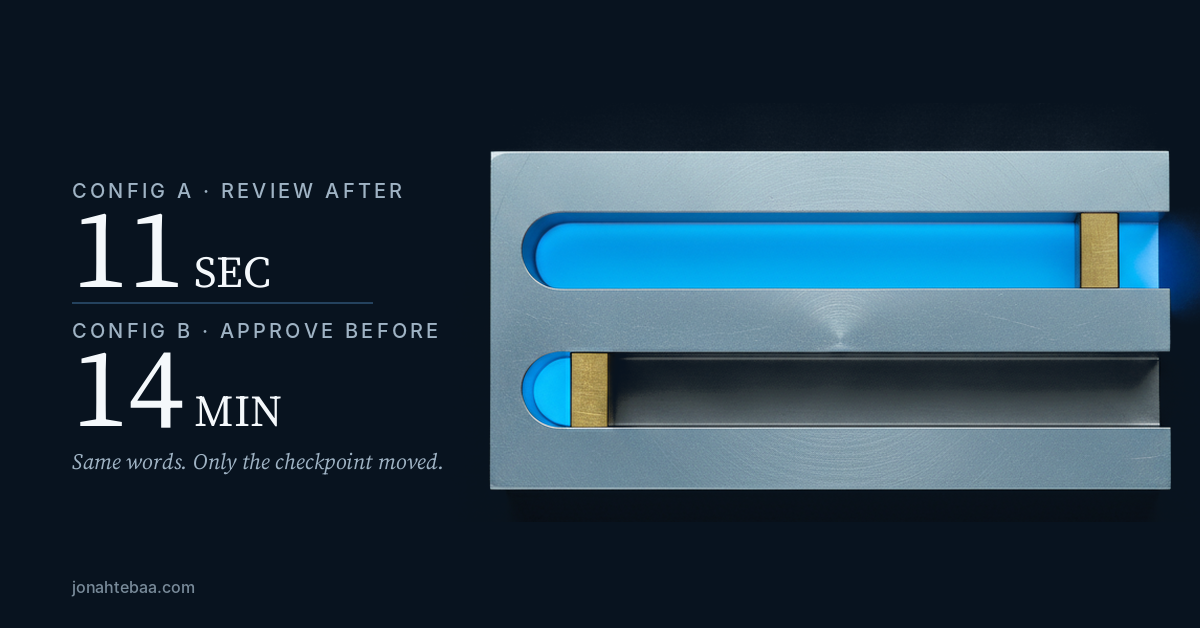
Two AI sales chat assistants, same script, same qualifying logic, same tone. One replies to an inbound lead in about eleven seconds. The other drafts the identical reply and then waits — on average just over fourteen minutes — for a person to approve it before it reaches the lead. Everything about the message is the same. The only variable that changed was where the human checkpoint sat in the sequence. The first version booked meetings at thirty-one percent. The second booked meetings at twelve percent.
Two Configurations, One AI
In my work testing AI chat for B2B service and SaaS pipelines, I ran two configurations of the same lead-qualifying assistant against comparable inbound volume — roughly one hundred leads a week, across four-week windows. I want to be clear about what this is: an illustration of a pattern I have seen repeat across several deployments, not a single definitive case study. The script logic, the qualifying questions, the tone, the calendar-offer language — all identical between the two setups. The only structural difference was checkpoint placement.
In Config A, the AI answers on its own. A lead asks a question, the AI replies in roughly eleven seconds, works through two or three qualifying questions, and offers an open slot on the calendar. No person touches that exchange before it goes out. A human reviews a sample of the transcripts afterward — not to approve them before sending, but to catch drift, check tone, and flag anything that needs a policy update.
In Config B, the AI drafts the same reply, using the same logic. But before it reaches the lead, it sits in a queue for a person to read and approve. That step is not automated slowness — it is a deliberate design choice, the one most people default to when they hear "AI is talking to our leads." The average time added by that single approval step was just over fourteen minutes per message.
From the lead's side, the experience is different in a way that has nothing to do with how good the answer is. In Config A, they ask a question and get a precise, on-script answer before they have finished checking their phone. In Config B, they ask the same question and wait — often long enough to have opened three other tabs, or moved on to a competitor who answered faster. Usability research has put that tipping point at roughly ten seconds, past which users will want to perform other tasks while waiting; a fourteen-minute approval queue is eighty-four times that limit.
What the Checkpoint Position Actually Cost
Response speed is not a soft variable in inbound sales chat — it behaves close to a threshold effect. Across the leads I have looked at, a reply inside one minute converts to a booked meeting at roughly thirty-four percent. A reply that takes five minutes or longer drops to about nine percent. That gap exists independent of which configuration produced the reply — it is simply what happens to buyer intent while a person is waiting.
Against that backdrop, the difference between Config A and Config B is not surprising, but the size of it is worth sitting with. Config A held a seventy-four percent contact rate — the share of leads who received a reply and engaged further — and converted thirty-one percent of total leads to a booked meeting. Config B held a thirty-nine percent contact rate and converted twelve percent to a booked meeting.
I want to repeat the part that is easy to skim past: the language was identical. The qualifying questions were identical. The tone, the calendar-offer phrasing, the follow-up logic — identical. Nothing about the quality of the AI's answers changed between the two configurations. The only thing that moved was when a human looked at the message relative to when it reached the lead. That one placement decision accounted for roughly two and a half times the booked-meeting rate.
The Question I Ask Before Placing a Checkpoint
The instinct behind Config B is not a bad one. Having a person check an AI's reply before a lead sees it feels like the responsible version of deploying AI in a customer-facing role. It is the version that is easiest to defend in a room full of stakeholders who are nervous about AI making a mistake in front of a prospect. But "responsible" and "safe" are doing a lot of unexamined work in that sentence, and the data above is what happens when nobody separates them from "slow." The alternative is not removing the human but moving them: I argue for putting the human checkpoint after the AI reply rather than in front of it, so review catches drift without standing between the lead and an answer.
The question I have started asking, for each category of message an AI handles, is not "is this reply good enough to send unsupervised." It is: for this category, does an imprecise answer cost more than a delayed one? Those are different questions with different answers depending on what is at stake in the message, and the honest answer changes category by category — it is not a single policy you set once for the whole system.
It is also worth separating this from a different problem entirely: an overloaded reviewer, a growing queue, a bottleneck in how fast approvals get processed. That is a throughput failure — a resourcing question about how many people are checking replies and how fast. What I am describing here is a different decision, made earlier: whether a pre-send checkpoint belongs in that message category's path at all. You can fully solve the throughput problem and still be routing the wrong categories through a human gate. I have written that other problem up separately, where lifting generation from fifteen to forty-five summaries a day simply relocated the constraint onto a fixed review capacity, and the fix was to segment by risk, push mechanical checks upstream, and count decisions finalised rather than drafts produced.
In practice, the categories split fairly cleanly once you look at what is actually at risk in each one. The risk on the pricing-and-commitment side is not hypothetical: in 2024 a British Columbia tribunal held Air Canada liable for a refund policy its own website chatbot had described inaccurately, finding that it makes no difference whether the information comes from a static page or a chatbot.
Where the pre-send checkpoint still earns its delay:
- Pricing exceptions and custom quotes
- Discount or contract-term requests
- Complaints or messages with sensitive or emotional language
- Anything that touches a binding commitment before the lead has a signed agreement
Where it usually doesn't:
- Standard qualifying questions (company size, timeline, budget range)
- Availability and scheduling offers
- Standard FAQ replies covered by an approved script
- Initial acknowledgments confirming a message was received
If you are deciding whether to put a human checkpoint before or after an AI's replies, I would not guess at the answer, and I would not apply one answer to the whole funnel. Define the message categories your AI actually handles. Route pricing exceptions and complaints through pre-send review. Let qualifying and scheduling replies go out on their own, with review happening on a sample afterward. Then measure contact rate and meeting-booked rate for each category over a few weeks. The pattern I found in my own testing may not be your exact numbers, but the shape of the trade-off — precision against speed, priced per category rather than per system — tends to hold.