
Why do initiatives fail after launch even when the strategy is right?
Because organizations confuse availability with implementation. Dr. Jonah Tebaa's last-mile test is five questions: who owns the outcome after launch, can a busy and interrupted person use it without asking three people what to do next, did the new way remove old work or only duplicate it, is there a standard rhythm of who checks what and when, and is there a feedback loop from real usage. A strategy that cannot survive an ordinary working day is still a concept.
The most expensive part of implementation is often the part nobody celebrates: making the new way of working feel ordinary.
There is usually energy at the beginning of an initiative. A problem is identified. A tool is selected. A process is redesigned. A pilot is launched. A presentation is prepared. People agree that the change is necessary.
Then comes the quiet part.
The meeting ends. The announcement is sent. The dashboard goes live. The system becomes available.
And this is where many organizations confuse availability with implementation.
I have seen this pattern often. The idea was not necessarily bad. The strategy was not necessarily weak. The tool was not necessarily the wrong one. The failure happened in the final stretch, where the new way of working had to cross from being approved to being used correctly, consistently, and calmly in real daily conditions.
The research on deployed systems reads the same way to me. A survey of machine-learning deployment case studies, Challenges in Deploying Machine Learning, maps the reported problems onto the stages of the deployment workflow and finds that "practitioners face issues at each stage of the deployment process" — the difficulty sits in the doing, spread across the whole path to daily use, not in the idea.
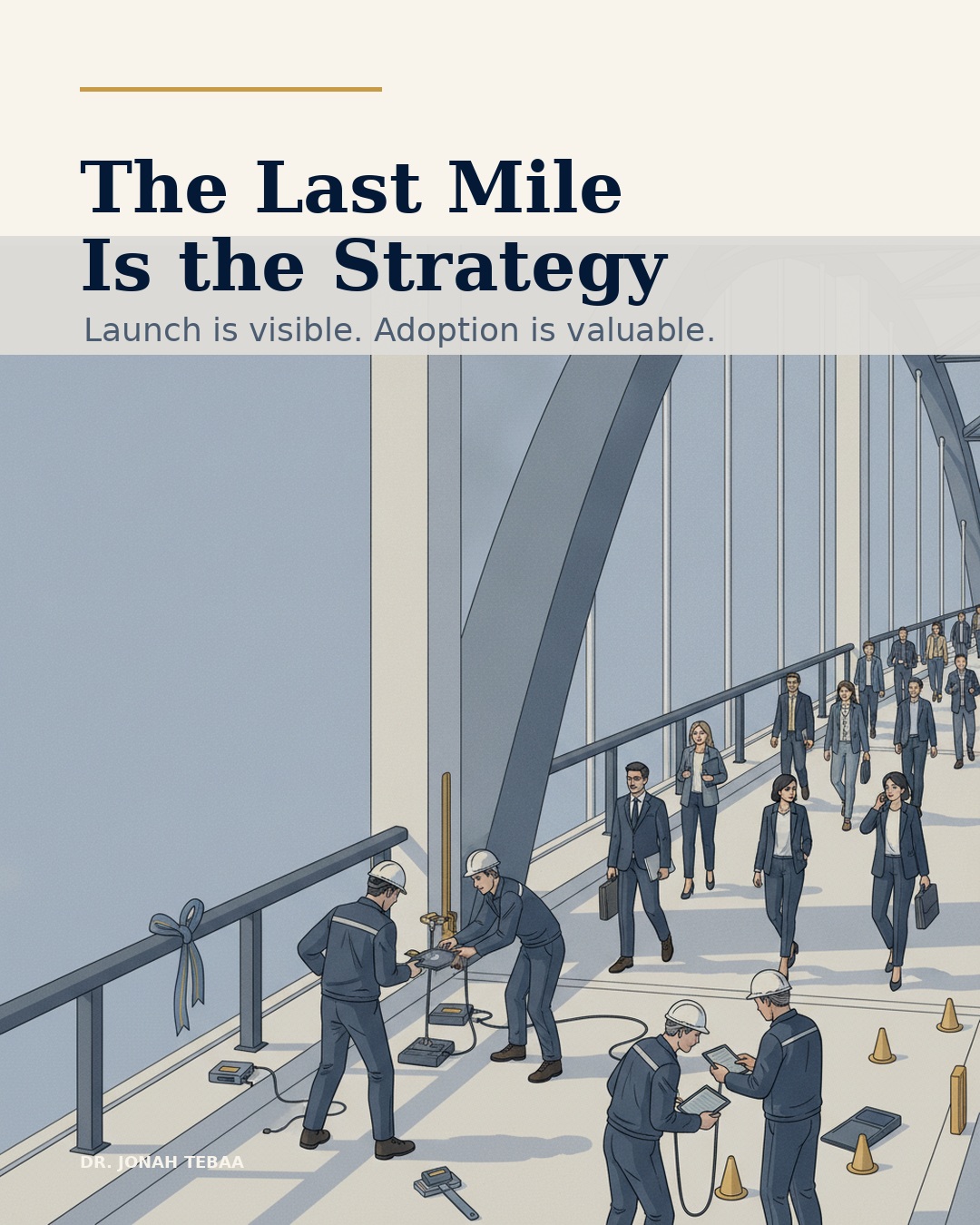
That final stretch is the last mile. It is where strategy becomes operational reality.
A new system is not implemented because it exists. It is implemented when the right person knows what to do, at the right moment, without needing to decode the organization around them. It is implemented when the workflow survives a normal working day, not only a launch day.
This is why I believe leaders should pay much closer attention to the last mile. It is not administrative detail. It is the strategy.
1. Who owns the outcome after launch?
Many initiatives have strong ownership before launch and weak ownership after launch.
Before launch, there is a project team, a sponsor, a vendor, a deadline, and a visible milestone. After launch, ownership can become vague. Everyone assumes someone else is watching adoption, training, data quality, user questions, exceptions, and performance.
If ownership disappears after launch, the initiative begins to drift. Small issues become normal. Workarounds multiply. People lose trust. The official process and the real process separate.
A last-mile implementation needs a named owner for the outcome, not only for the setup. The question is simple: after the announcement, who wakes up caring whether this is being used properly?
2. Can a busy person use it without asking three people what to do next?
This is one of my favorite practical tests.
Do not test the process only with the motivated users, the project team, or the people who already understand the logic behind it. Test it with someone busy, interrupted, and under normal pressure.
Can they understand what to do next? Can they find the right place to start? Do they know what information is required? Do they know when to use the new process and when not to? Do they know what to do if something goes wrong?
If a capable employee needs to ask three people what the workflow means, the workflow is not yet clear enough. The organization may have launched something, but it has not translated the change into daily behavior.
3. Did the new way remove work, or did it create duplicate work?
Duplicate work is one of the clearest signs that adoption has not happened.
A new tool is introduced, but people still maintain the old spreadsheet just in case. A new approval flow is created, but decisions still happen in messages. A new reporting system goes live, but managers still ask for manual summaries because they do not yet trust the dashboard.
Sometimes this is understandable during transition. But if duplicate work remains for too long, the organization has not implemented a new way of working. It has added another layer.
A serious implementation plan should identify what stops, not only what starts.
- What old step is removed?
- What old report disappears?
- What old approval is no longer needed?
- What old habit must be retired?
4. Is there a standard rhythm?
Implementation needs rhythm.
A system that is used whenever people remember is fragile. A process that depends on constant reminders is not embedded. A dashboard nobody reviews at a fixed time becomes decoration. A workflow nobody checks becomes optional.
The last mile requires boring clarity.
- Who checks what?
- When do they check it?
- Where does the work happen?
- How is progress measured?
- What happens when something breaks?
- Who is informed when the process is not followed?
These questions may not sound strategic, but they are. Without rhythm, the organization relies on memory, personality, and urgency. With rhythm, the process becomes part of the operating system of the business.
A good implementation does not only ask, “Is the tool ready?” It asks, “Where does this live in the week?”
5. Is there a feedback loop from real usage?
The people closest to the work will usually see the friction first.
They will know which field is confusing, which handoff is late, which step is duplicated, which exception happens more often than expected, and which part of the process sounds logical in theory but fails in practice.
If there is no feedback loop, leadership may receive a clean launch report while the daily users are quietly building workarounds. That is how implementation quality decays.
A last-mile feedback loop does not need to be complicated. It can be a weekly review, a short survey, a shared issue log, or a recurring conversation with the people using the workflow. What matters is that feedback is expected, captured, and acted on.
The hidden value of boring clarity
The last mile is rarely glamorous. It is handoffs, ownership, training, documentation, measurement, repetition, and follow-up. It is making sure that people know who does what, when, where, how, and what happens if the process breaks. Software stumbles on exactly the same stretch, which is why AI agents fail at the last mile.
But this is where business value is won.
A strategy that cannot survive daily operations is not yet a strategy. It is a concept. A tool that people do not trust is not yet transformation. It is software. A process that depends on reminders is not yet embedded. It is still being pushed from the outside.
The most important implementation question is not, “Did we launch?” It is, “Has the new way of working become ordinary enough to last?”
Because ordinary is not a low ambition. In implementation, ordinary is the point. Ordinary means the behavior has crossed into the real life of the organization. Ordinary means people are no longer performing change for leadership; they are simply doing the work in the better way.
So before celebrating the next launch, I would look closely at the final 10%.
- Who owns it?
- Can people use it under pressure?
- What old work has been removed?
- What rhythm keeps it alive?
- What feedback improves it?
The last mile is not the cleanup after strategy. The last mile is the strategy becoming real.